Places & Scenes 1960s Modesto, California Grassroots
Modesto: Draggin’ 10th
Modesto's cruise, the one American Graffiti was set in, grew until the city barred passing the same spot on McHenry more than once every four hours.
Confidence MediumHow we know this
- Confidence
- Medium
- Source types
- Grassroots newspaper (LA Times Feb & Mar 1990), city ordinance record (Stanislaus County Library), historical marker (HMdb), museum page
- Last verified
- 2026-10-13 (Round 8)
- Open issues
- ⚠ ban year (1990 ordinance vs 1993 "banned")
- Location
- In George Lucas's teens, a loop of 10th, G, 11th and O Streets, with Burge's Drive-In (the model for Mel's in American Graffiti) at the turnaround. From the late 1960s it moved to McHenry Avenue.12
- Peak
- 1950s to 1980s.
- Later
- the "Graffiti Summer" events and the Kiwanis American Graffiti car show.
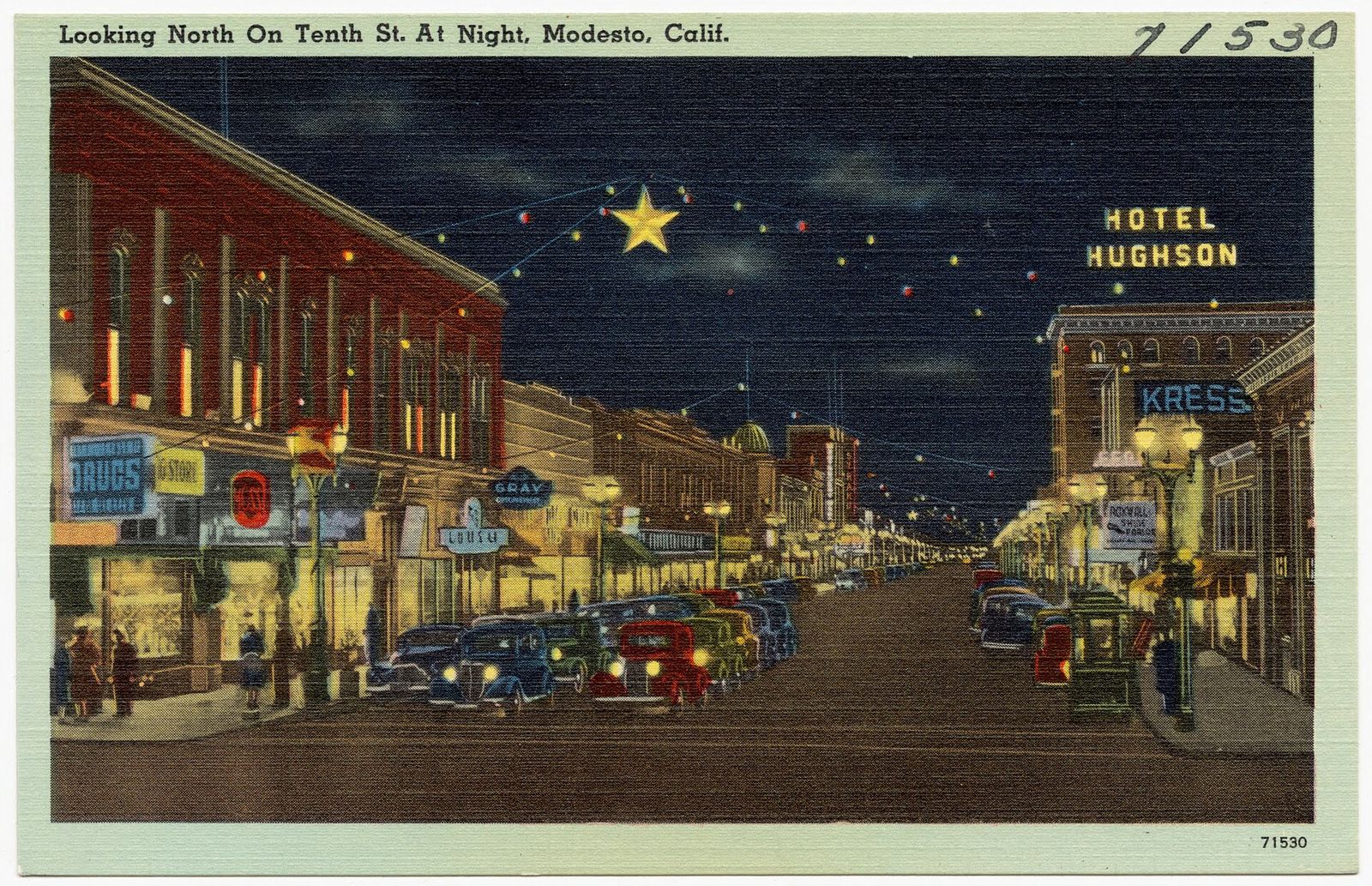
"Looking North On Tenth St. At Night, Modesto, Calif.", a Tichnor Brothers postcard from about 1930–45. It shows 10th Street before the "Draggin' 10th" era. Creator: Tichnor Brothers, Publisher. Date: between circa 1930 and circa 1945date QS:P,+1950-00-00T00:00. Source: Wikimedia Commons. License: Public domain.

The cruise the film was set in, and the ordinance on McHenry
Modesto’s cruise is the one the film was set in, and the city later barred passing the same spot on McHenry more than once every four hours.
In George Lucas’s teens, it was a loop of 10th, G, 11th and O Streets, with Burge’s Drive-In (the model for Mel’s in American Graffiti) at the turnaround. From the late 1960s it moved to McHenry Avenue.12
When George Lucas was a teenager, “draggin’ 10th” was the place to cruise (LA Times 1990).
American Graffiti (1973) was set in a 1962 version of Modesto, which the LA Times describes as “a small valley town of about 30,000,” though most of the film was shot elsewhere.2
Then the cruise outgrew the town. By 1990, according to city officials, up to 6,000 teenagers from around the San Joaquin Valley crowded McHenry Ave on weekend nights.3
In their own words
That year the police chief and a car-club leader weighed in:
“The days are long gone when a couple hundred local guys drove up and down the street looking for girls.”
— Police Chief Gerald McKenzie, LA Times (Feb 6, 1990).2
“Cruising is part of our history, part of our life style here.”
— Phillip (Tiny) Stuart, past president of the Modesto Area Drag Racer’s Assn., 1990.2
Policing
The city acted. On March 27, 1990, the city passed anti-cruising and anti-loitering ordinances. One barred passing the same spot on McHenry more than once every four hours. Dennis Lema of the Central California Coalition of Car Clubs vowed to challenge them.43⚠ Whether that ban is the 1990 ordinance or 1993 is still open.
The film and the main drag
The film was set on that cruise. The city barred passing the same spot on McHenry more than once every four hours. For the late-1940s club scene behind the cruise, see Modesto’s Century Toppers.
See also: Woodward.
Open questions & disputed details
1 item
From the detective’s notebook: where the sources disagree, where we have only one, and what we are still looking for. Each item links back to its place in the story.
Disputed. 1993? The HMdb marker text says that after Graffiti Night grew huge, “Cruising was banned in Modesto; an ordinance that remains in force today.” That contradicts the documented 1990 ordinance. It may be a second measure or simply a mistake on the marker.5 ↩
Not yet sourced: the film’s influence on the 1970s street-rod revival is often claimed, but we haven’t sourced it yet.
Images
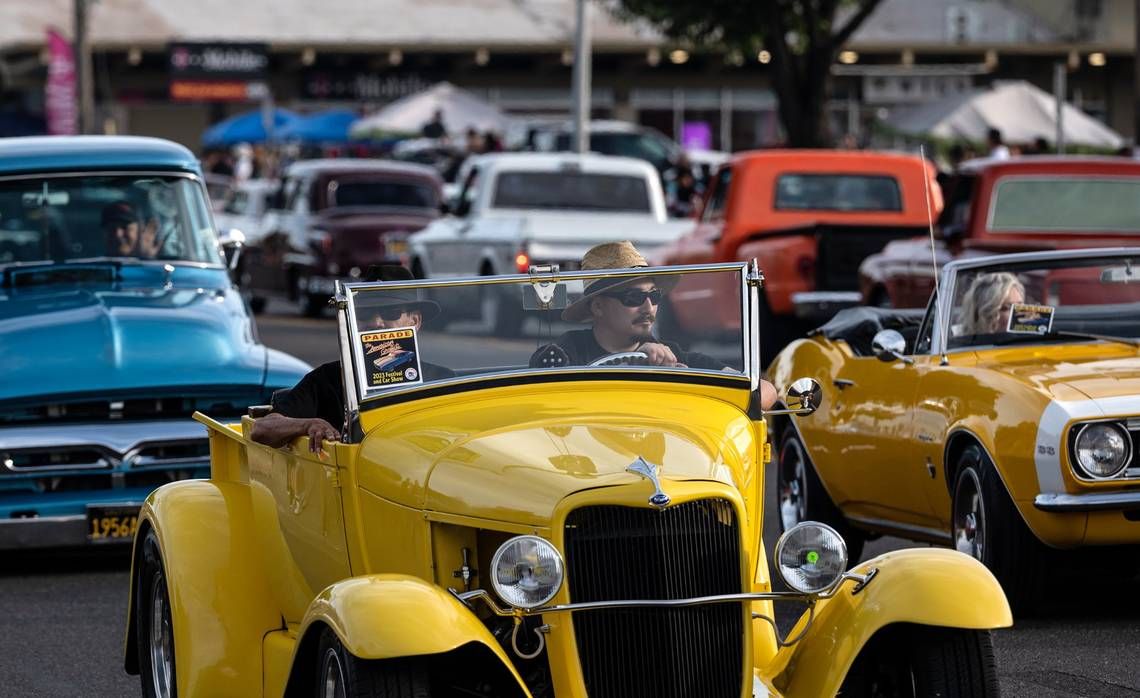
Car show at the American Graffiti festival, Modesto, June 2024. This is the revival. Creator: Andy Alfaro. Date: 2024-06-04. Source: Wikimedia Commons. License: CC0.

Sources & notes
5 notes
-
Graffiti USA Classic Car Museum, “Modesto Historic Cruise Route.” https://www.graffitiusamuseum.com/cruise_route/ (accessed 2026-10-13) ↩
-
LA Times, “Modesto Made It Immortal but Now May Ban Cruising” (Feb 6, 1990). https://www.latimes.com/archives/la-xpm-1990-02-06-mn-195-story.html (accessed 2026-10-13) ↩↩↩↩
-
Miles Corwin, “Modesto’s Cruisers Vow to Defy New Ban,” LA Times (Mar 29, 1990). https://www.latimes.com/archives/la-xpm-1990-03-29-mn-199-story.html (accessed 2026-10-13) ↩↩
-
Stanislaus County Library, Stanislaus Memory Project, “Modesto Cruising Ordinance” (1990-03-27). https://www.stanislauslibrary.org/memories/about_ordinance.shtm (accessed 2026-10-13) ↩
-
HMdb, “Graffiti Summer” historical marker. https://www.hmdb.org/m.asp?m=223773 (accessed 2026-10-13) ↩