Drag Racing & Strips 1960s Illinois Grassroots
Hog Butcher on Weekdays, Fun Capital on Sundays: the Beardstown Drag Strip (Beardstown, Ill., 1967–72)
Beardstown, a packing-house town on the Illinois River, drew 2,000 people to its new drag strip in 1967 and called Sundays its Fun Capital. In 1972 Don Garlits was on the bill against Ken Dobson.
Confidence LowHow we know this
- Confidence
- Low
- Source types
- Grassroots daily newspaper (Jacksonville Daily Journal, Jacksonville, Ill.): a Beardstown correspondent's column, sports notes and display ads, 1967–72, read as scanned page OCR; one encyclopedia entry for background
- Last verified
- 2026-10-22 (Round 20)
- Open issues
- whether the 1967 "Seward Drag strip on the Arenzville road" and the 1970s "Beardstown Drag Strip" are the same place ◐; the founder, the exact site and the closing year are unknown; the Garlits match race was announced, and we have no report of the result ◐
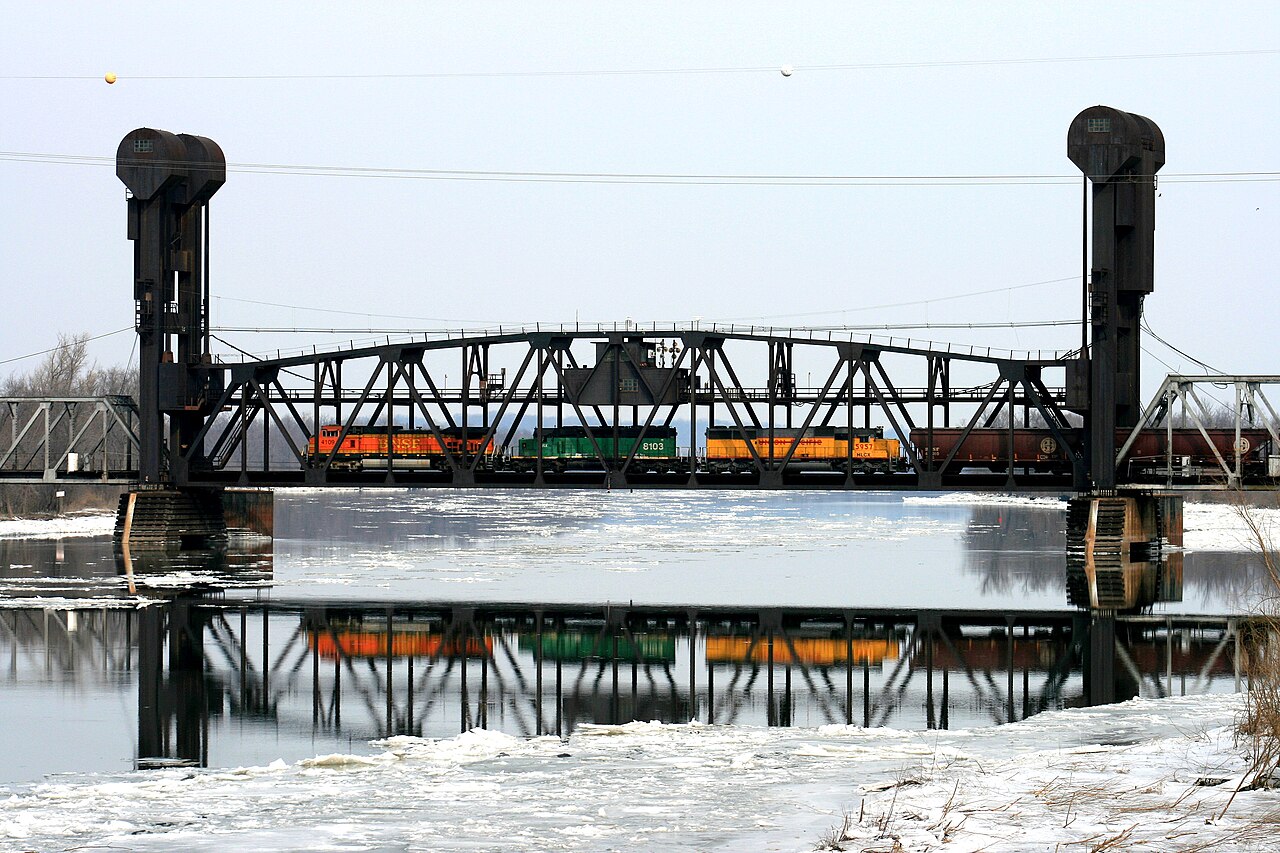
The Illinois River lift bridge at Beardstown, Illinois, in 2007. Context only; no photo of the strip has turned up. Photo: Rick from Baton Rouge, Feb. 12, 2007. Source: Wikimedia Commons. License: CC BY 2.0.

Hog butcher on weekdays, 2,000 people on opening day in 1967, and Garlits on the bill in 1972
In their own words
“Beardstown is getting back to reinforcing its reputation as Fun Capital on Sundays.”
— Beardstown column, Jacksonville Daily Journal, May 28, 1967.1
Beardstown sits on the Illinois River in Cass County, a packing-house town with a lift bridge. On weekdays the town had a reputation as hog butcher of Illinois. In the spring of 1967 Sundays were Fun Capital, and the new strip drew 2,000 people on opening day. In 1972 Garlits was on the bill against Ken Dobson, and the result is still open.
The town, the column said, had “apparently done everything possible to establish a reputation as ‘hog butcher of Illinois’ on weekdays.” On weekends it was packed with bowlers for the annual KC tournament, “and for the past two weeks additional sports fans have been crowding in for drag races. The Seward Drag strip on the Arenzville road attracted 2,000 people on opening day, and apparently did just as well or better the following Sunday.” Spectators paid $1.50 apiece. The strip “had cars parked for more than a mile along each side of the entrance — on both sides of the Arenzville blacktop.”1◐
The strip was still running three years later. By 1970 ads in the Jacksonville paper billed the Beardstown Drag Strip for an A.H.R.A. Super Stock Circuit date, with a car show, time trials from 9 a.m. to 1:30 p.m. and races at 2. Children under 12 got in free with an adult.2 That May, “E. J. Potter presented the feature attraction at Sunday’s drag racing program at the Beardstown Drag Strip. Potter made three runs on his Chevy-powered” machine (the rest of the line is lost in the scan).3 Potter, the “Michigan Madman” from Ithaca, Mich., toured the strips for 13 years with motorcycles built around V8 engines.4
Two years later it changed hands. In May 1972 the ads read “DRAG RACING EVERY SUNDAY … Beardstown DRAG STRIP New Owner & Operator” Ken Dobson, with “AHRA SANCTIONED DRAGS.”5 Two weeks later the Jacksonville sports column told fans they had “a treat in store this weekend at the Beardstown Drag Strip, promoted by Ken Dobson of Jacksonville.” There would be racing Friday and Saturday nights and Sunday afternoon, “with perhaps the top name in all of drag racing, ‘Big Daddy’ Don Gorlits [sic] pitted against Dobson in a special match race Friday evening.”6◐
Like Malden, Mo. in the same years, it ran under AHRA rather than NHRA sanction. Compare Sedalia’s unfinished strip for a Midwestern town that never got that far. The 1967 page also ran a story on Beardstown’s wartime Civilian Pilot Training program and a newly opened airport, and nothing in the column ties the strip to either field.◐?
On weekdays it was the hog butcher of Illinois. On a Sunday in 1967 the strip drew 2,000 people. In 1972 Garlits was on the bill, and the result is still open.
Open questions & disputed details
4 items
From the detective’s notebook: where the sources disagree, where we have only one, and what we are still looking for. Each item links back to its place in the story.
Single source so far. Who built the Seward strip, and how long was it? The 1967 column gives the crowd and the gate but no owner, length or clubs.1 ↩
Single source so far. Did Garlits race Dobson? The 1972 column announced the match race;6 we have not found the result. ↩
Open question. Was the strip on an airfield? The same 1967 column that reported the strip also wrote about Beardstown’s wartime pilot-training program and a new airport, but nothing ties the strip to either field.1 ↩
Next leads
The Beardstown Illinoian-Star and the Cass County Historical Society, for who built the Seward strip and where it was; Ken Dobson’s own story; whether the Garlits match happened; when the strip closed. ↩
Sources
6 notes
-
Beardstown correspondent’s column, Jacksonville Daily Journal (Jacksonville, Ill.), May 28, 1967. Page OCR (quotes corrected for OCR slips). https://archive.org/details/jacksonville-daily-journal-1967-05-28 (accessed 2026-10-22) ↩↩↩↩
-
Beardstown Drag Strip display ad, Jacksonville Daily Journal, May 1, 1970. Page OCR. https://archive.org/details/jacksonville-daily-journal-1970-05-01 (accessed 2026-10-22) ↩
-
Beardstown drag racing note, Jacksonville Daily Journal, May 20, 1970. Page OCR, partly lost. https://archive.org/details/jacksonville-daily-journal-1970-05-20 (accessed 2026-10-22) ↩
-
“E. J. Potter,” Wikipedia, citing Paul Vitello, New York Times, May 12, 2012. https://en.wikipedia.org/wiki/E._J._Potter (accessed 2026-10-22) ↩
-
Beardstown Drag Strip display ad, Jacksonville Daily Journal, May 27, 1972. Page OCR (owner’s first name garbled). https://archive.org/details/jacksonville-daily-journal-1972-05-27 (accessed 2026-10-22) ↩
-
Sports column, Jacksonville Daily Journal, June 9, 1972. Page OCR. https://archive.org/details/jacksonville-daily-journal-1972-06-09 (accessed 2026-10-22) ↩↩