People & Builders 1940s Glendale, California
Tom Beatty and the “Rust Bucket”
Tom Beatty's unpainted, rusty 1929 Ford roadster ran 154.63 mph in 1951. He built a belly tank in the car port next to Navarro's shop, and it was SCTA Top Speed of the Season five straight years.
Confidence MediumHow we know this
- Confidence
- Medium
- Source types
- oral (Navarro via AHRF), period magazine (via auction text), auction catalog
- Last verified
- 2026-10-12 (Round 2)
- Open issues
- Record conflicts open
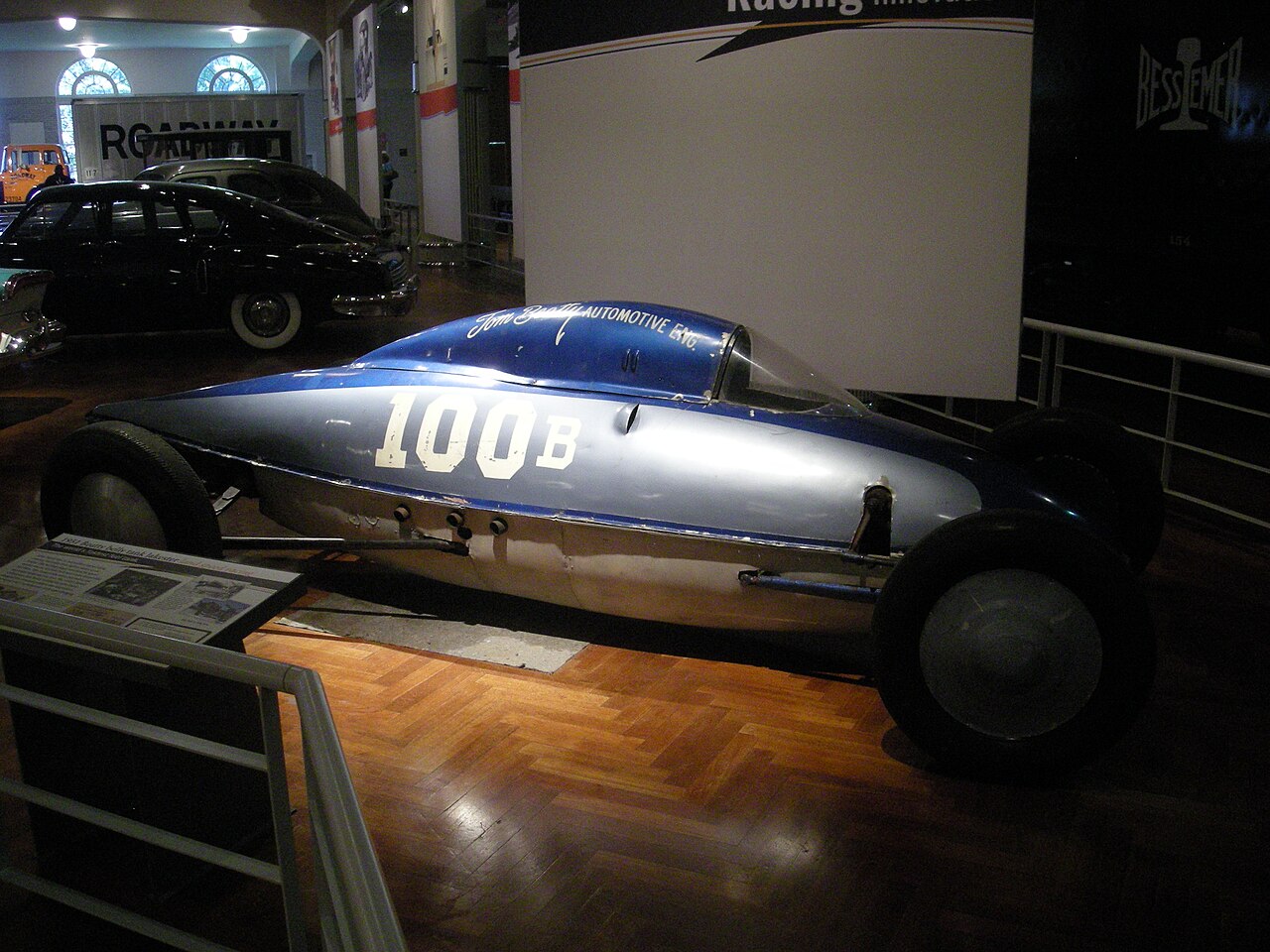
The belly tank lakester that the Henry Ford Museum displays as the "1951 Beatty belly tank lakester" (Dearborn, Mich., 2012). The identification is the photographer's and the museum's. We have not checked it against the Beatty records discussed below. Photo: Michael Barera, 2012-08-24. Source: Wikimedia Commons. License: CC BY-SA 4.0.

An unpainted, rusty 1929 Ford ran 154.63 mph in 1951, and the belly tank from the car port next door was Top Speed of the Season
Tom Beatty’s channeled 1929 Ford roadster was unpainted and rusty, looking “gutted by a fire” (Hop Up, August 1951). It was clocked at 154.63 mph in 1951 with a ’41 block, Navarro heads and manifold, and a GMC two-stroke diesel blower. It used an upside-down Model A front suspension, and the steering wheel was stripped to the wire core and wrapped in friction tape.3◐ AHRF calls the car a ’27.
Beatty was a Glendale club man. Barney Navarro joined the club in 1940 along with Tom Beatty, George Hill and Doane Spencer.1⚠ AHRF writes Glendale Strokers. The spelling is still open.
He built the belly tank in the car port next door. That tank was SCTA Top Speed of the Season.
The two stayed close. Navarro: “Tom lived next door to my shop and had a covered car port where he could do the welding and assembly work.”1
That car port produced the belly tank. Beatty built a ¾-in. chrome-moly truss chassis with swing-axle independent rear suspension, a modified Ford gearbox, and an inverted Model A front axle. Hop Up (Dec 1951) wrote: “Finally an original tank has come along.”4⚠
In 1952 came 203 mph one-way and a 197.17 mph two-way record per AHRF.1 RM has 203.61 one-way. It was Hot Rod’s “Hot Rod of the Month” (Nov 1952) with a Rex Burnett cutaway.4
RM says it was SCTA Top Speed of the Season five straight years (1951–55). It reached 211.267 mph in 1955, the 16th member of the 200 MPH Club. It switched to Olds power in 1958.4 In 1958 he opened Tom Beatty Automotive Engineering, Sun Valley, selling 6-71 blower manifolds and multi-belt drives.4 It was Top Speed of the Season again in 1959, and ran a 243.438 mph average in 1962.4◐ The roadster was unpainted and rusty, and it ran 154.63 mph in 1951. The belly tank from the car port next door was SCTA Top Speed of the Season five straight years (1951–55), and again in 1959.
See also: the Denver Timing Association, whose charter member Bob Olds remembered Beatty letting him drive the belly tanker one way at Bonneville.
Open questions & disputed details
4 items
From the detective’s notebook: where the sources disagree, where we have only one, and what we are still looking for. Each item links back to its place in the story.
Disputed. A ’27 or a ’29? The Rust story describes the roadster’s build;3 AHRF calls Beatty’s Navarro-blown car a “’27.”1 ↩
Disputed. Strokers or Stokers? AHRF writes “Glendale Strokers”;1 Kustomrama’s club page is titled “Glendale Stokers.” Kustomrama lists members including Beatty, Navarro, Spencer, Hill, Don Nicholson, Mac Schutt, Bob “Buzz” Buswell, Bill Davis and the Watson brothers.2 Kustomrama’s Buswell caption also mentions a “Glendale Sidewinders,” and Coachbuilt calls the Sidewinders “(Glendale, CA), the SCTA’s first member club.”5 The relationship between the clubs is unclear. The spelling needs a period source, such as an SCTA entry list or a club plaque photo. ↩
Disputed. 185.80 or 188.284 mph in 1951? AHRF gives a Class D Lakester record of 185.80 mph;1 the RM Auctions text on Kustomrama gives a 188.284 mph run.4 These may be a two-way record and a one-way best, which is unconfirmed. ↩
Single source so far. 211, then 243 mph? The 1955 and 1962 speeds come from an auction catalog; they need checking against SCTA/BNI records.4 ↩
Unresolved: the RM text says Beatty “died later that year” after the tank was sold, but the sale date is unclear. Death date unverified.
Visual references (external)
These are copyrighted or rights-restricted images, so we link to them instead of copying them.
Sources & notes
5 notes
-
Tony Thacker, “Barney Navarro,” AHRF. https://ahrf.com/pioneer/barney-navarro/ (accessed 2026-10-12) ↩↩↩↩↩↩
-
Kustomrama, “Glendale Stokers.” https://kustomrama.com/wiki/Glendale_Stokers (accessed 2026-10-13) ↩
-
Kustomrama, “Tom Beatty’s 1929 Ford” (citing Hop Up, Aug 1951). https://kustomrama.com/wiki/Tom_Beatty’s_1929_Ford (accessed 2026-10-13) ↩↩
-
Kustomrama, “Tom Beatty’s Belly Tank Lakester” (RM Auctions catalog text). https://www.kustomrama.com/wiki/Tom_Beatty%27s_Belly_Tank_Lakester (accessed 2026-10-12) ↩↩↩↩↩↩↩
-
Coachbuilt.com, “George DuVall.” http://www.coachbuilt.com/des/d/duvall/duvall.htm (accessed 2026-10-13) ↩