Drag Racing & Strips 1950s Missouri, Kansas Grassroots
The Sedalia Drag-Ons: Courtesy Cards, Half Fines and a Truck for a Boys’ Ranch (1957–64)
Sedalia's Drag-Ons spent seven years trying to earn a drag strip and never got one. They left courtesy cards, a half-fine rule, and in 1964 a rebuilt 1950 truck for a boys' ranch.
Confidence MediumHow we know this
- Confidence
- Medium
- Source types
- Grassroots small-town daily newspaper (Sedalia Democrat, Sedalia, Mo.): club meeting notes, a sports editor's column printing the club president's letter (1958), and a Sunday feature with the club's bylaws (1964), all read as scanned page OCR
- Last verified
- 2026-10-18 (Round 17)
- Open issues
- founding date and founders not found; whether the 1962 club was the same organization revived or a new one under the old name is not stated; the club's later history after 1964 is unknown; nearly all of it comes from one paper ◐
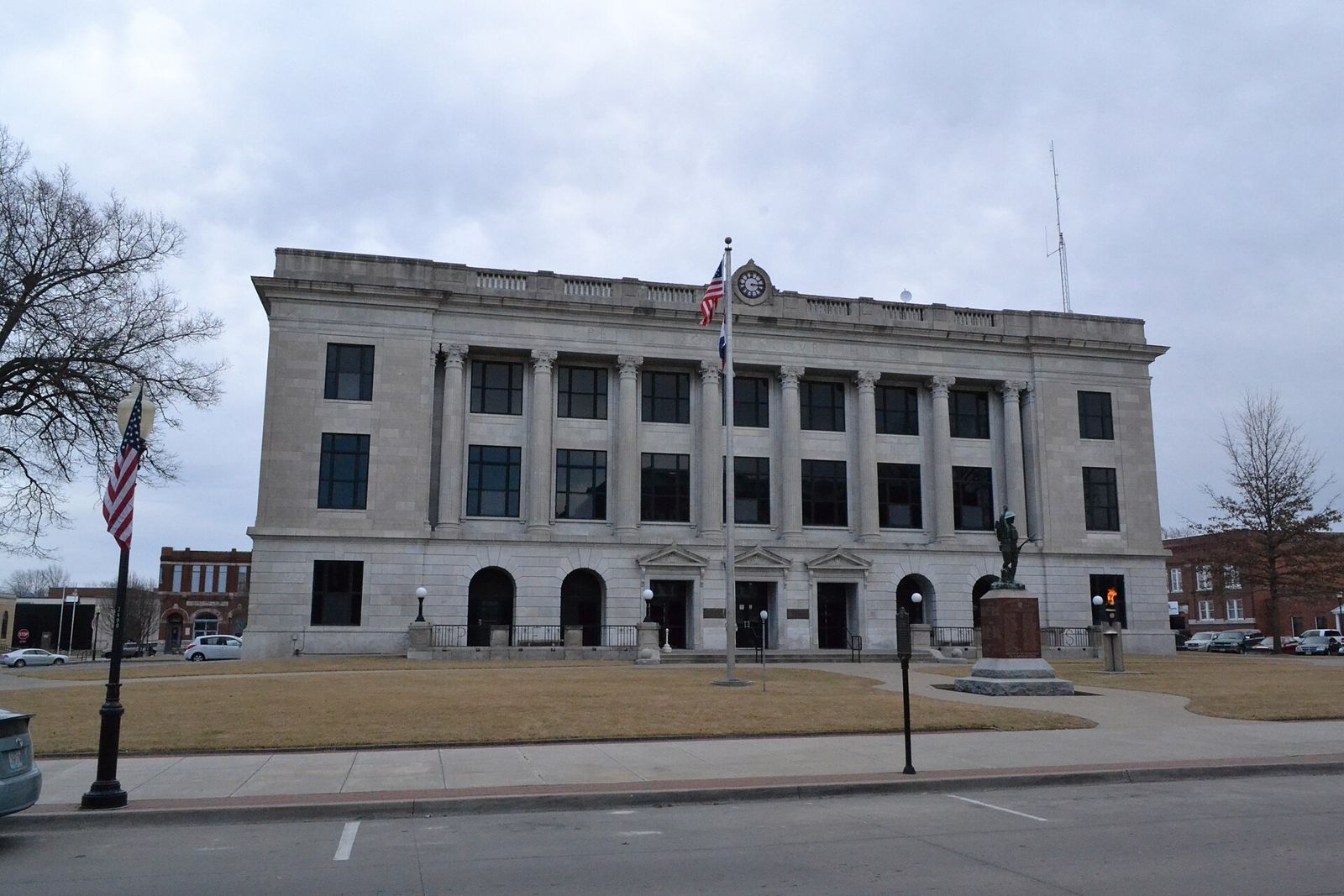
The Pettis County Courthouse in Sedalia, where the Drag-Ons met in 1957 (photo 2018). Creator: 25or6to4. Date: 2018-02-03. Source: Wikimedia Commons. License: CC BY-SA 4.0.

Seven years trying to earn a strip they never got, courtesy cards, half fines, and a truck for a boys’ ranch
In their own words
“We want Sedalia to be more than just a spot on the map. We want it to be known over Missouri as the safest city in the state.”
— Jr. Vasquez, president, the Sedalia Drag-On’s, letter to sports editor D. Kelly Scruton, Sedalia Democrat, March 9, 1958.3
Sedalia’s Drag-Ons spent seven years trying to earn a drag strip and never got one. Courtesy cards, half fines, and a truck for a boys’ ranch are what the local paper kept, one of the most detailed rulebooks of any small-town club.
Home of the State Fair, Sedalia, Missouri, sits in the farm country east of Kansas City. In the late 1950s the town had no drag strip.
The Drag-Ons met at the courthouse in June 1957. A trip was set for the coming weekend to the Kansas City strip, which the paper described as a National Hot Rod Association strip. Soon, the paper said, motorists helped by a member would be handed a courtesy card, and the wording the paper printed was: “You Have Been Helped By The DRAG-ONS of SEDALIA, A MOTOR CAR CLUB. Dedicated to the Safety and Courtesy of the American Highways. ‘We Hope You Have a Safe Trip.’”1 (The scan’s columns are interleaved, so the wording is pieced together from the OCR.)
That same meeting heard that “not a fatal accident has ever occurred on a sanctioned drag strip,” and that the only deaths had been among those racing illegally.1◐
Two weeks later the members went to the Kansas City strip, where “Many of the local boys participated.” The June 18 vote, back home, was that every member “must belong to the National Hot Rod Association,” and they scheduled the safety check for July.2 Kansas City’s own clubs had used the same courtesy-card idea; see The Detective Whose Son Was a Dragster.
The case went into print the next spring. D. Kelly Scruton, sports editor of the Democrat, gave his March 1958 column to a letter from the club’s president, Jr. Vasquez. Three laws, Vasquez wrote, bound the Drag-Ons: obey the motor vehicle laws, be courteous to other drivers and pedestrians, and “publicize the sport of drag racing in its true light.”3
The penalty was blunt. A member found guilty of breaking the rules “is fined by the club, but given one more chance to prove himself worthy of membership. If caught again, he is fined by the club, the city police, and disregarded as a club member.”3
Vasquez’s real point was the strip. Only a strip could take racing off the highways, he wrote, and “The citizens of Marshall have already realized this and are giving full support to their hot rod club, which is now being formed.”3 Scruton backed the idea, but he was frank about the club’s start. When the Drag-Ons were first organized, he wrote, some members “failed to keep faith with these rules and regulations.”3
That spring the club read and approved its constitution at its own clubhouse.4 Sue Wilson, chairman of the Sedalia cancer drive, signed the members up, and their “Operation Simo-Wash” car wash at the Wayne Richardson Service Station on May 10 raised $60.40 for the Cancer Society.5
The Push Rods of Marshall were the guests at a June 1958 meeting, probably the new club Vasquez had mentioned. The Drag-Ons planned to go to drag races at Whiteman Air Force Base on Sunday, June 8, sponsored by the base’s club, with cars expected from Kansas City and Great Bend, Kansas. They also booked a July 4 “Record Hop” at the Liberty Park Convention Hall: $1 stag, $1.50 drag.6 For Great Bend, see Great Bend, Kansas.
Then the trail goes quiet. In January 1962 Scruton wrote that drag strips were “up for discussion again” now that the Drag-Ons had revived, added that the club “should however, keep going and quit running hot-and-cold,” and noted that members had been helping stranded motorists and pushing cars out of the recent storms.7 A week later President Bill Bottcher read a list of custom car shows to a meeting at the club building on East 14th, and the members called a special meeting to choose jackets.8
That revived club joined the 1962 push for a Sedalia strip, a story of its own: see The Big S.I.R.. A May 1963 trip to the Kansas City strip was rained out, and the club made plans to attend the nationals at Indianapolis, Aug. 30 to Sept. 2.9
Last came the best story. The Democrat’s Sunday feature section, in November 1964, ran a full page by Larry Embry headlined “Drag-Ons Rebuild Old Car For Gift to Boys’ Ranch.”10
Tom Butterfield was setting up a boys’ ranch near Marshall on the old Marshall Country Club property, and he had only a station wagon. “We voted it in pretty quick,” said club president Larry Rennison. Walter McClure, who lived northeast of Sedalia and hadn’t been able to sell his 1950 truck, gave it to the club. The members did the work in Dick Schultz’s garage on East Third: new upholstery, an overhauled motor, a new bed floor and a repaint in the original color. The truck was due at the ranch in December.10
Embry also printed the club’s rules, and they had grown teeth since 1958.10 The club’s purpose was “to promote road safety and courtesy on American highways,” and to show the public what organized hot rod clubs can do. Members were mostly in their late teens and early 20s, aged 17 to 27.
A moving violation “means a fine of one-half his court fine,” and the member then had to stand trial before his fellow club members at the next meeting. A member in an accident had to report it, and three members investigated. Expulsion took a two-thirds vote. Every member’s car got a safety check every three months.
Dues were $2 to join, which covered the plaque, then 50 cents a week. Members were fined for missing meetings, and two absences in four weeks put membership at risk. The club insignia was a cast aluminum license plate.
In 1964 the officers were Rennison (president), Gary Hayden (vice president), Dennis Smethers (secretary), Dick Schultz (treasurer), Gary Deuel (reporter) and Steve Bottcher (sergeant-at-arms).10?
Courtesy cards, half fines, a truck for the ranch. They never got the strip.
See also: Kansas City’s strip and Timing Association, The Big S.I.R., Escanaba’s Drag-n’s, Stroudsburg’s Ridge Runners and Kingston’s Igniters.?; Flares, Tow Chains and a Broken Gasket.
Open questions & disputed details
3 items
From the detective’s notebook: where the sources disagree, where we have only one, and what we are still looking for. Each item links back to its place in the story.
Single source so far. Never a death on a sanctioned strip? That was the club’s talking point in 1957, not a statistic the paper checked.1 ↩
Open question. Where did the half-fine rule come from? No source says any club got it from another. It may have come from a common model, such as NHRA’s club materials, but we haven’t found that model.10 ↩
The club fine rules. Several small-town clubs made a member pay twice for a traffic ticket. Belleville’s Gear Jammers had him pay the club a sum equal to half his fine; the Sedalia Drag-Ons charged one-half his court fine and put him on trial before the club; Stroudsburg’s Ridge Runners took up to one-half of the fine. Escanaba’s Drag-n’s suspended a member for 30 days instead. No source says any club copied another. Full story: Belleville’s Gear Jammers.
Next leads
The Marshall Democrat-News for the Push Rods; Whiteman AFB base newspaper for the June 1958 drags; Butterfield Youth Services’ own history for the truck; the 1957 founding meeting. ↩
Sources
10 notes
-
Drag-Ons meeting item, Sedalia Democrat (Sedalia, Mo.), June 5, 1957. Page OCR, columns interleaved. https://archive.org/details/sedalia-democrat-1957-06-05 (accessed 2026-10-18) ↩↩↩
-
“Drag-On Clubbers Visit KC Drag Strip,” Sedalia Democrat, June 19, 1957. Page OCR. https://archive.org/details/sedalia-democrat-1957-06-19 (accessed 2026-10-18) ↩
-
D. Kelly Scruton, sports column printing a letter from Jr. Vasquez, president, the Sedalia Drag-On’s, Sedalia Democrat, March 9, 1958. Page OCR. https://archive.org/details/sedalia-democrat-1958-03-09 (accessed 2026-10-18) ↩↩↩↩↩
-
Drag-Ons meeting item, Sedalia Democrat, April 30, 1958. Page OCR. https://archive.org/details/sedalia-democrat-1958-04-30 (accessed 2026-10-18) ↩
-
Drag-Ons car wash item, Sedalia Democrat, May 14, 1958. Page OCR. https://archive.org/details/sedalia-democrat-1958-05-14 (accessed 2026-10-18) ↩
-
Drag-Ons meeting item, Sedalia Democrat, June 4, 1958. Page OCR. https://archive.org/details/sedalia-democrat-1958-06-04 (accessed 2026-10-18) ↩
-
D. Kelly Scruton, sports column, Sedalia Democrat, Jan. 7, 1962. Page OCR. https://archive.org/details/sedalia-democrat-1962-01-07 (accessed 2026-10-18) ↩
-
Drag-Ons meeting item, Sedalia Democrat, Jan. 16, 1962. Page OCR. https://archive.org/details/sedalia-democrat-1962-01-16 (accessed 2026-10-18) ↩
-
Drag-Ons meeting item, Sedalia Democrat, May 21, 1963. Page OCR. https://archive.org/details/sedalia-democrat-1963-05-21 (accessed 2026-10-18) ↩
-
Larry Embry, “Drag-Ons Rebuild Old Car For Gift to Boys’ Ranch, Promoting Road Safety, Good Will,” Sedalia Democrat (Sunday feature section, with the Sedalia Capital), Nov. 15, 1964. Page OCR. https://archive.org/details/sedalia-democrat-1964-11-15 (accessed 2026-10-18) ↩↩↩↩↩