Drag Racing & Strips 1950s Iowa Grassroots
The Professor’s Drag Strip: Ames, Iowa, and the Nightcrawlers (1957–1959)
An Iowa State College math professor stood up for the Nightcrawlers and served as steward of the Ames Drag Strip, which ran the summers of 1957, 1958 and 1959.
Confidence MediumHow we know this
- Confidence
- Medium
- Source types
- Grassroots historical society page and newsletter (Ames History Museum, quoting an Ames Tribune feature of June 2, 1958, and reproducing a 1957 ad); a regional magazine feature (The Iowan, Feb–Mar 1959); the December 1957 Ames telephone directory (scanned)
- Last verified
- 2026-10-17 (Round 16)
- Open issues
- grandstand or no grandstand ⚠; who owned the land ⚠; the museum's "1st quarter-mile strip in Iowa" sits awkwardly beside a Des Moines strip that The Iowan mentions ⚠; the reason given for the closing rests on the museum page alone ◐; we have not traced Dr. Lambert after 1959
A math professor stood up for the Nightcrawlers, and their strip south of Ames ran the summers of 1957, 1958 and 1959
In their own words
“Some people think I’m just plain crazy to spend most of my Sundays out here.”
— Dr. Robert Lambert, Iowa State College mathematics professor and steward of the Ames Drag Strip, to Pat Lounsbury in The Iowan, February–March 1959.1
An Iowa State College math professor stood up for the Nightcrawlers and served as steward of the Ames Drag Strip through the summers of 1957, 1958 and 1959. One day in the late 1950s, back at his car in downtown Ames, he found an overtime parking summons on it. He had stayed too long at a service club, where he’d been speaking up for a hot rod club and its drag strip. Somebody got to the ticket before he did. Inside the envelope were fifty cents and a note on a torn scrap of brown paper:
“From a Nightcrawler who wants to show some small thanks for the support you have shown us in the interest of cars.”1
The professor was Dr. Robert Lambert. The Nightcrawlers were the club he had helped start, made up of Iowa State students and local boys by the Tribune’s account.2 Their big project was a quarter-mile of concrete, oiled dirt and timing lights south of town.
The Ames History Museum says the strip was built to get the kids off the streets where they had been racing: 13th Street near Dayton Road, and the old Airport Road. It sat two miles south of Ames, east of Highway 69 behind the Solar Inn. The cars ran east toward the Skunk River on ground once used as a landing strip by the Gerbracht Aeronautic Corporation. According to the museum, the City Council approved it unanimously, Lloyd’s of London wrote the risk insurance, and it ran in the summers of 1957, 1958 and 1959.2
A 1957 ad, reproduced in the museum’s newsletter, gives the routine: “2 Miles South of Ames on Hwy. 69,” timing at 10 a.m., eliminations at 2:00 p.m., and the initials A.T.A.A. at the bottom.3 By December the strip was in the telephone book as “Ames Drag Strip Hwy 69 S,” and it was listed again in the yellow pages under Race Tracks.4
The Iowan’s writer found it by a homemade sign and a plain dirt road. At the starting line stood a frame control tower, about ten feet square. Cars came off the line on 200 feet of concrete. They ran an oiled dirt road to the quarter-mile finish, used another quarter mile to slow down, and came back on a separate return road. Transmissions broke “about once every thousand starts,” he was told.1 The Tribune of June 1958 says the club and local businesses had added 200 feet of concrete to the original sixty, and hoped to pave the whole quarter someday. The museum’s figure is 260 feet paved, with electric timing.2
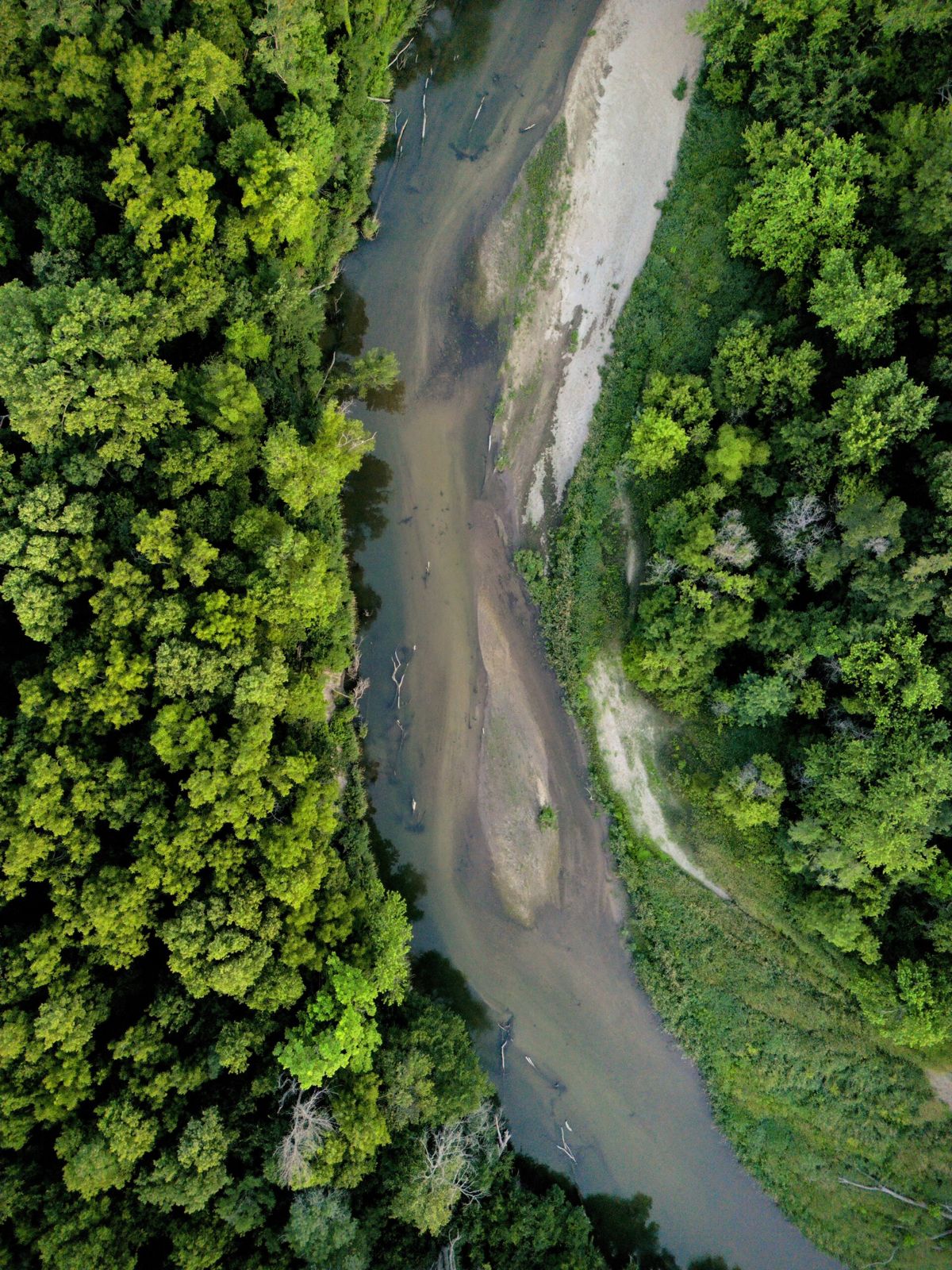
The South Skunk River at Ames, the river the strip’s cars raced toward. A modern photo, for context only; it does not show the strip site. Creator: SubrataPalStat. Date: 2023-07-06. Source: Wikimedia Commons. License: CC BY-SA 4.0.
Visual references (external): the Ames History Museum page shows the 1957 ad, the new starting tower of 1957, the 1958 starting-line paving and the Gulliver brothers’ straight-eight Buick. The Iowan feature has photos by Pat Lounsbury and Jon Morgan (scan).
The Iowan described Lambert as “a tall, unassuming Navy veteran in his middle thirties.” His official title was track steward. He had worked with hot rod groups for four years. He got into it, he said, by accident: “I fell into this thing by chance.” He was invited to a drag race at the Nevada airport, entered his own car and won.1
His wife, Betty, shared his enthusiasm. But she told the magazine that some friends had politely disapproved: “they implied they thought we were lowering ourselves considerably.” Lambert said he wished more people knew that “a well-guided hotrod club can be a troublesaver—not a troublemaker.”1
The club’s backers make an unlikely pit crew. The Iowan lists the head of the psychology department, the head of mechanical engineering, a Presbyterian minister, the retired head of the Highway Commission, a feed-company man, a dean, and the dean’s secretary, Margaret White. Businessman J. D. Armstrong is also on the list.1 The Tribune identified him as “city council.”2 By the Tribune’s June 1958 count, White chaired the advisory board and the police chief sat on it. She told the paper that “nothing could be safer than dragging.”2
Lambert told the magazine the money side was what made the strip unusual. Entries paid a dollar plus a 25-cent pit pass. Every car went through a safety check. The club carried public liability insurance. The trophies ran “about one hundred dollars’ worth a week.” By the time the story ran, the strip had been open two seasons and had drawn more than 500 entries in its 15-week season the summer before. “The only other permanent drag strip installation in Iowa—at Des Moines—is owned by a private investor, not a hotrod club,” Lambert said.1
The club stressed safety and courtesy. The Tribune gave the club’s aims in the order the club gave them: “Safety, education and fun -- in that order.” Each Nightcrawler carried a membership-courtesy card. Rules came from the national headquarters of the Automobile Timing Association of America, with 30 points of safety inspection, according to the Tribune. The paper also quoted a letter to the police chief from a Northrup King advertising manager. His starter had failed while he was passing through Ames late one evening. Some club members went out of their way to get his car going. He praised “their most refreshing courtesy and thoughtfulness.”2?
The sources disagree on the grandstand. The Iowan says, “There are no grandstands or bleachers.” The museum says the strip “featured a grandstand,” along with pits, the starting tower and a concession stand run by Helen Overland.12⚠ The Iowan writer seems to describe 1958 while the museum covers all three summers, so a grandstand added late would fit both. No source says that, though.
The sources disagree on the land. The Iowan says Armstrong donated the land rent-free. The Tribune puts the strip on the J. D. Armstrong property but says it was “owned by Bud Overland,” and the museum says the land belonged to Armstrong and to Bud and Gunner Overland.12⚠
Then there is the word first. The museum calls Ames “the 1st quarter-mile strip in Iowa.” Lambert himself told The Iowan about a permanent strip at Des Moines, and a private investor owned it.21⚠
Three summers is all the strip lasted. The museum’s page ends the story in one sentence. When Bud Overland lost both his best friend and his brother in automobile accidents, he lost interest in the drag strip, and it closed after the summer of 1959.2◐
Lambert had stood up for the club. The note in the parking ticket said thanks. The strip ran the summers of 1957, 1958 and 1959, and then it closed.
Open questions & disputed details
5 items
From the detective’s notebook: where the sources disagree, where we have only one, and what we are still looking for. Each item links back to its place in the story.
Open question. Was the ATAA still running after 1957? That ATAA line matters beyond Ames. Elsewhere in the archive, the ATAA is said to have been “absorbed” by the NHRA in 1957 (Bob Bartel), and that claim is single-source. Yet an ATAA ad ran in Ames in August 1957, and the club was still citing ATAA rules in June 1958. Both can be true if the strips kept running under the old rules after the merger, but neither page settles it. ↩
Disputed. Was there a grandstand? The Iowan says, “There are no grandstands or bleachers.” The Ames History Museum says the strip “featured a grandstand,” along with pits, the starting tower and a concession stand run by Helen Overland.12 One may describe a later season; we don’t know which. ↩
Disputed. Whose land was it? The Iowan calls the site D. Armstrong’s property but also says it was “owned by Bud Overland”; the museum says the land belonged to Armstrong and to Bud and Gunner Overland.12 A county plat or deed for 1957–59 would settle it. ↩
Disputed. Was Ames Iowa’s first quarter-mile strip? The museum says so;2 Lambert himself told The Iowan about a permanent strip at Des Moines.1 The Des Moines strip’s own history site now dates its first day of racing to July 13, 1957, but that is a local historian’s site, not a primary source, and the Ames strip’s 1957 opening day is not in our sources, so the order is still open (Des Moines Dragway). ↩
Single source so far. Why did it close? Only the Ames History Museum says Bud Overland lost interest after his best friend and his brother died in car accidents, and that the strip closed after the summer of 1959.2 Lead: the Ames Tribune for 1959–60. ↩
Sources
4 notes
-
Pat Lounsbury, “Welcome Drag Racers,” The Iowan (Shenandoah, Iowa), vol. 7, no. 3, February–March 1959, pp. 12–13, 50, read as page OCR; photos by Pat Lounsbury and Jon Morgan. https://archive.org/details/sim_iowan_february-march-1959_7_3 (accessed 2026-10-17) ↩↩↩↩↩↩↩↩↩↩↩↩↩
-
Ames History Museum (Ames Historical Society), “Ames Drag Strip,” including a transcription of “Fun, Education With Safety Are Aims of Ames Drag Strip Enthusiasts,” Ames Tribune, June 2, 1958. https://ameshistory.org/content/ames-drag-strip (accessed 2026-10-17) ↩↩↩↩↩↩↩↩↩↩↩↩↩↩
-
“Summers at the Ames Drag Strip,” Ames History Newsletter (Ames Historical Society), June 2013, read as scanned OCR (reproduces a 1957 ad for Sunday, Aug. 4). https://archive.org/details/2013-newsletter-2 (accessed 2026-10-17) ↩
-
Northwestern Bell, Ames, Iowa, telephone directory, December 1957, alphabetical and classified listings (“Race Tracks”). https://archive.org/details/1957.12amestelephonedirectory (accessed 2026-10-17) ↩