Drag Racing & Strips 1950s Texas Grassroots
A Car Fixed the Way a Person Likes It: the Cameron Accelerators and Krenek’s Garage (Cameron, Tex., 1956–63)
For seven years teenagers in Cameron, Tex., kept reviving a hot rod club at Charlie Krenek's garage. In 1956 the airport manager was to ready a strip, and in 1963 S. J. Wohleb offered his farm, and the paper never says either strip was used.
Confidence MediumHow we know this
- Confidence
- Medium
- Source types
- Grassroots weekly newspaper (The Cameron Herald, Cameron, Tex.): club notices, a column written by a club member, a photo caption, an editorial and a year-in-review, 1956–63, read as scanned page OCR, with the 1963 strip story checked against the page image, as was the 1956 airport story
- Last verified
- 2026-10-22 (Round 22-West)
- Open issues
- whether the 1956 airport strip or the Wohleb farm strip was ever used ◐; how the 1956, 1957 and 1963 clubs were related ?
A teenage club kept starting over at Krenek’s garage, with an airport strip in view in 1956 and a farmer’s land in 1963
In their own words
“Do you want to know what a hot rod really is? It is a car fixed the way a person likes it.”
— “By An ‘Accelerator’,” a club member’s column, The Cameron Herald, May 31, 1956.1
For seven years a teenage hot rod club in Cameron kept going quiet and starting up again, always at Charlie Krenek’s garage. Each time the club wrote bylaws and asked the town to trust it. In 1956 an airport runway was in view. In 1963 S. J. Wohleb said the club could have his farm. The paper never says the airport strip or the farm strip was used. Cameron is the seat of Milam County, a farm town east of Temple in Central Texas.
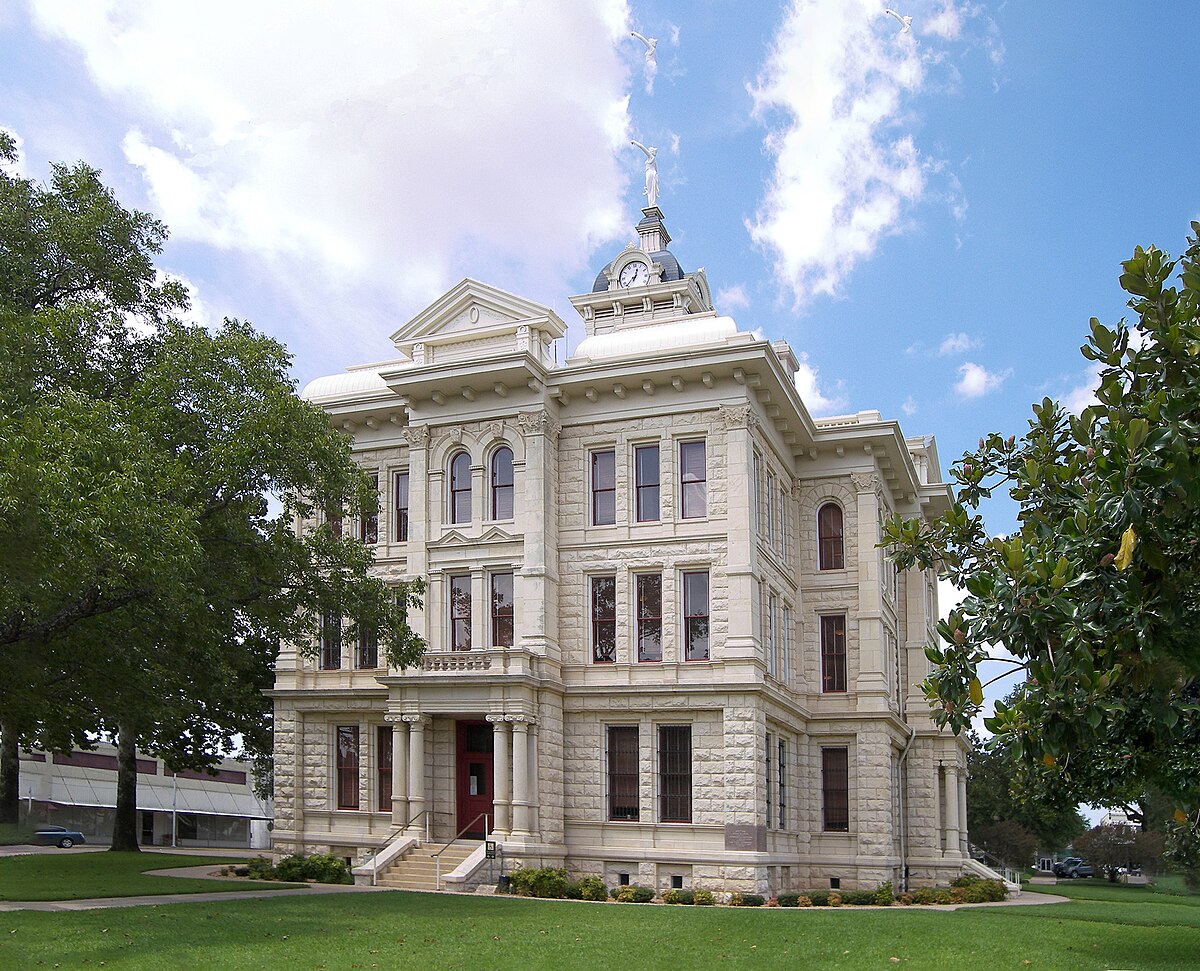
The Milam County Courthouse, Cameron, Texas. Context only; it does not show the club or its garage. Creator: Larry D. Moore. Date: 2008-08-22. Source: Wikimedia Commons. License: CC BY 4.0.

In May 1956 the Herald’s headline asked a question: “Cameron ‘Accelerators’ Getting Drag Strip(?).” The story opened, “The National Association of Hot Rodders moved into Cameron on March 16.” The club met every Thursday night at Charlie L. Krenek’s garage and had 21 members, with Gene Mitchan as president, Louis Krenek as vice president and Billy Slavik as reporter. “Krenek allows the teen-agers the run of his garage, tools and all,” for demonstrations and for work on their hot rods and stock cars after each business meeting. Safety, the story said, was “one of the cardinal principals” of the club.2 How Louis Krenek was related to Charlie L. Krenek, the paper does not say.?
The question mark in the headline was about the airport. “Most important development in the new organization here now is the advent of a ‘Drag’ strip at the airport,” the paper wrote. “A strip at the Rogers controlled airport is about to be readied by the airport manager for the boys to have their races each Sunday.” The runway was long enough for the full quarter mile, but it was “considered 420 feet too short for a regulation course” because the cars needed room to stop past the finish line. The details were still being worked out, “using the Temple, Gatesville and Waco strips as examples,” with perhaps a fifty-cent gate fee for every car and a $1 “Drag fee.” Police Chief Willie Dolan had told the club’s meeting “I am all for you, the whole police force will do everything we can for you,” and the First National Bank agreed to lend its loudspeakers for the weekend races.2
Three weeks later a member answered the town in print, in a column signed “By An ‘Accelerator.’” It began: “Some people think a hot rod is a car that has been chopped and dropped down a couple of inches with dual exhaust and a high powered engine to give it more speed.” That was partly right, the writer said, but people who called a hot rod something “all souped up so it can go fast and kill people” should not jump to conclusions. His definition is quoted at the top of this page.1
The club had faded by the next winter. In February 1957 Billy Slavik, the 1956 club’s reporter and now “president of the Cameron Hot Rod Club,” called young men to a meeting at Krenek’s Speed Shop “for the reforming of the club.” The members wanted to build one hot rod for races sponsored by the national association. Their aim was to develop racing engines “while at the same time not having to endanger others by holding drag races in streets,” and to race only under the rules of the National Hot Rod Association.3 Whether Krenek’s Speed Shop and Charlie’s Garage were the same business, the paper does not say.
Two weeks later 19 youths were meeting weekly as the Accelerators, and the paper ran their case under the headline “Cameron Hotrod Enthusiasts Seek Understanding Of Adults.” The bylaws required members to learn and obey traffic laws. Members reported for violations would be suspended for a time that depended on how serious the violation was. The city police and the Texas Highway Patrol would be given the license numbers of every member’s car. The boys wanted to buy a club car and build it into “a vehicle capable of setting new speed records,” and they needed a business or group to sponsor them so they could affiliate with the national association. Parents would be invited to meetings.4
The next week a photo showed two members with their trophies. Burke Barr had won his in Class A races, and J. T. “Toddy” Lawrence had taken one in Class C at a drag race in Temple. The caption called them “the only members” of the new club “that have been successful competitors in recognized drag races.”5 In March the club met with the Cameron Rotary Club. An editorial said the boys “impressed those men more with their intelligence than with talk of reckless driving.”6
There was somewhere to race by 1960. The Herald’s review of that year recorded that Leon Ernest “won Top honors at Little River Drag Strip, winning F and E classes in his 49 Plymouth.”7 Little River Drag Strip is named once, with no location.
In May 1963 the Accelerators met at “Charlie’s Garage” and organized again. Chuck Krenek was elected president, Bobby Hughes vice president, Wally Short reporter, and Shirley Baker secretary-treasurer. The club’s main aim, the paper said, was “to abolish ‘hot rodding’ and teach members to become safe drivers.” Krenek said the club needed the support of adults as well as teenagers in enforcing its safety rules.8 How Chuck Krenek was related to Charlie L. Krenek, the paper does not say.
A week later the club had land. The headline read “Drag Strip Is Planned Here: Accelerators Start Building Plans On S. J. Wohleb Farm.” The farm was “just off the Temple Highway and about two miles outside of the city limits.” Wohleb had two sons in the club, and he told the members they could have the land for a strip “as long as they wanted the land.” He explained why: “The boys have tried for a long time to get a strip around here and have never been able to get the land.” The plan was about half a mile of road, with a quarter mile for dragging, and stands if they could manage them. The photo showed the club’s president at work: “DRAGGING MOTOR - Chuck Krenek, president of the Accelerators.”9 We found no later story saying the 1956 airport strip or the Wohleb farm strip was built or used.◐
The same club name lasted seven years, and the meetings stayed at Krenek’s garage. A Krenek was an officer in 1956 and the president in 1963. For another Texas club of the same years, see Canyon’s Orchids, Plugs and Celtics, and for a club and an airfield strip near San Antonio, see Medina County’s Castroville drags. For a Missouri club with similar bylaws, see the Sedalia Drag-Ons.?
In 1956 the club had an airport runway in view, and in 1963 a farm. The meetings stayed at Krenek’s garage. The paper never says the airport strip or the farm strip was used.
Open questions & disputed details
3 items
From the detective’s notebook: where the sources disagree, where we have only one, and what we are still looking for. Each item links back to its place in the story.
Open question. Were the Kreneks one family business? We do not know how Louis Krenek and Chuck Krenek were related to Charlie L. Krenek, or whether “Krenek’s Speed Shop” (1957) and “Charlie’s Garage” (1963) were the same business.2 ↩
Single source so far. Were the strips ever built? We found no later story saying the 1956 airport strip or the Wohleb farm strip was built or used. The 1960 “Little River Drag Strip” is named once, with no location.9 ↩
Next leads
Cameron Herald issues from summer 1956 for races at the airport and from summer 1963 for the Wohleb strip; the Temple Daily Telegram for the Temple drag races of 1957 and the Little River strip; Milam County deed records; the Krenek family. ↩
Sources
9 notes
-
“By An ‘Accelerator’,” The Cameron Herald (Cameron, Tex.), May 31, 1956. Page OCR. https://archive.org/details/cameron-herald-1956-05-31 (accessed 2026-10-22) ↩↩
-
“Cameron ‘Accelerators’ Getting Drag Strip(?),” The Cameron Herald, May 10, 1956. Page OCR, checked against the page image (quotes corrected for OCR slips; “principals” as printed). https://archive.org/details/cameron-herald-1956-05-10 (accessed 2026-10-22) ↩↩↩
-
“Hot Rod Club To Be Formed,” The Cameron Herald, Feb. 7, 1957. Page OCR. https://archive.org/details/cameron-herald-1957-02-07 (accessed 2026-10-22) ↩
-
“Cameron Hotrod Enthusiasts Seek Understanding Of Adults,” The Cameron Herald, Feb. 21, 1957. Page OCR. https://archive.org/details/cameron-herald-1957-02-21 (accessed 2026-10-22) ↩
-
“Cameron Hot-Rod Drag Race Winners,” photo caption, The Cameron Herald, Feb. 28, 1957. Page OCR (Lawrence’s surname garbled; spelled as in the Feb. 21 member list). https://archive.org/details/cameron-herald-1957-02-28 (accessed 2026-10-22) ↩
-
Editorial, The Cameron Herald, Mar. 21, 1957. Page OCR. https://archive.org/details/cameron-herald-1957-03-21 (accessed 2026-10-22) ↩
-
Year-in-review, The Cameron Herald, Jan. 5, 1961. Page OCR. https://archive.org/details/cameron-herald-1961-01-05 (accessed 2026-10-22) ↩
-
Accelerators organizational meeting, The Cameron Herald, May 9, 1963. Page OCR. https://archive.org/details/cameron-herald-1963-05-09 (accessed 2026-10-22) ↩
-
“Drag Strip Is Planned Here: Accelerators Start Building Plans On S. J. Wohleb Farm,” The Cameron Herald, May 16, 1963, p. 6. Checked against the page image. https://archive.org/details/cameron-herald-1963-05-16 (accessed 2026-10-22) ↩↩