Companies & Shops 1960s Florida, Ohio Grassroots
Crane Cams: The Machinist’s Son Who Ground His Own
Harvey Crane found a California camshaft "wasn't accurately made," ground his own, and built Crane Cams from Hallandale to Daytona. In 1966 each class winner at the Nationals got a refund of the cam and kit.
Confidence MediumHow we know this
- Confidence
- Medium
- Source types
- Grassroots local-newspaper obituary (Orlando Sentinel, 2013), funeral-home obituary (Lohman Funeral Homes, 2013), SEMA News obituary and heritage pieces, a patent, archive pages built on racer-journalist sources
- Last verified
- 2026-10-16 (Round 15)
- Open issues
- ⚠ birthplace (Ojus vs Hallandale); ⚠ "retired" vs ousted in 1989; ⚠ when computer cam design began; ⚠ number of first-show exhibitors; the unnamed California cam maker is unidentified
A machinist’s son ground his own cam after he found a California one wasn’t accurately made, and a refund for the little guys
In their own words
“I always want to keep my mind busy and stay curious of the amazing new developments we are seeing every day in this industry.”
— Harvey Crane Jr., shortly before his 80th birthday, as quoted in SEMA’s obituary (2013).3
Harvey Crane bought a camshaft from a California company, hoping it would make his hot rod go. He found it “wasn’t accurately made.” So, the Orlando Sentinel says, he ground one to his own exacting specifications, and made that his life’s work.1 That work became Crane Cams, from a rented corner in Hallandale to a plant in Daytona. In the Sentinel’s story, the inaccurate cam came from the California trade of The Camgrinder Wars, though the maker is unnamed. In 1966 the winner of each class at the Nationals got the price of the Crane cam and kit back.
The skill was one he had grown up with. He was a machinist’s son whose father repaired and fabricated parts, and Harvey learned the equipment young. Whether he was born in Ojus or Hallandale is still open.⚠ As a teenager in South Florida he raced his own 1939 Ford coupe in the illegal drag races held at airstrips and secluded streets, and he learned to build engines to be more competitive.1 SEMA says he discovered hot rods at 13, was known by his teens for fast, reliable flathead V-8s, and at 18 left home to tour the Midwest’s rough dirt tracks, tuning a pair of flathead-powered “jalopy” racers.3 SEMA’s later heritage piece says he ground his first camshaft in 1946, at 15, for a Henderson motorcycle engine in a midget racer.4
On January 1, 1953, per his funeral-home obituary and SEMA, he opened Crane Engineering in a rented corner of his dad’s machine shop in Hallandale.23 In 1987 he told the Sentinel that his first year did $10,000 in business.1 As the paper reports them, the early customers he named were some of the best-known track racers in the Carolinas and Virginia, “including Junior Johnson, A.J. Foyt and Ralph Earnhardt.”1 Although many thought of Crane as a drag-racing cam company, SEMA adds that his earliest business was selling flathead cams to early NASCAR heroes.3
The patent can be checked. US 3,108,580, “Non-rotatable valve tappet,” by Harvey J. Crane Jr. of Hallandale, was filed March 13, 1963, and issued October 29, 1963. It describes a roller lifter held from turning by a plate across two adjacent lifters. Among the patents it cites is Ed Iskenderian’s 1958 “Guide means for non rotatable valve lifters” (US 2,846,988). Ed Iskenderian and Patents cover the lifter-guide patent that Crane’s tappet patent cites.
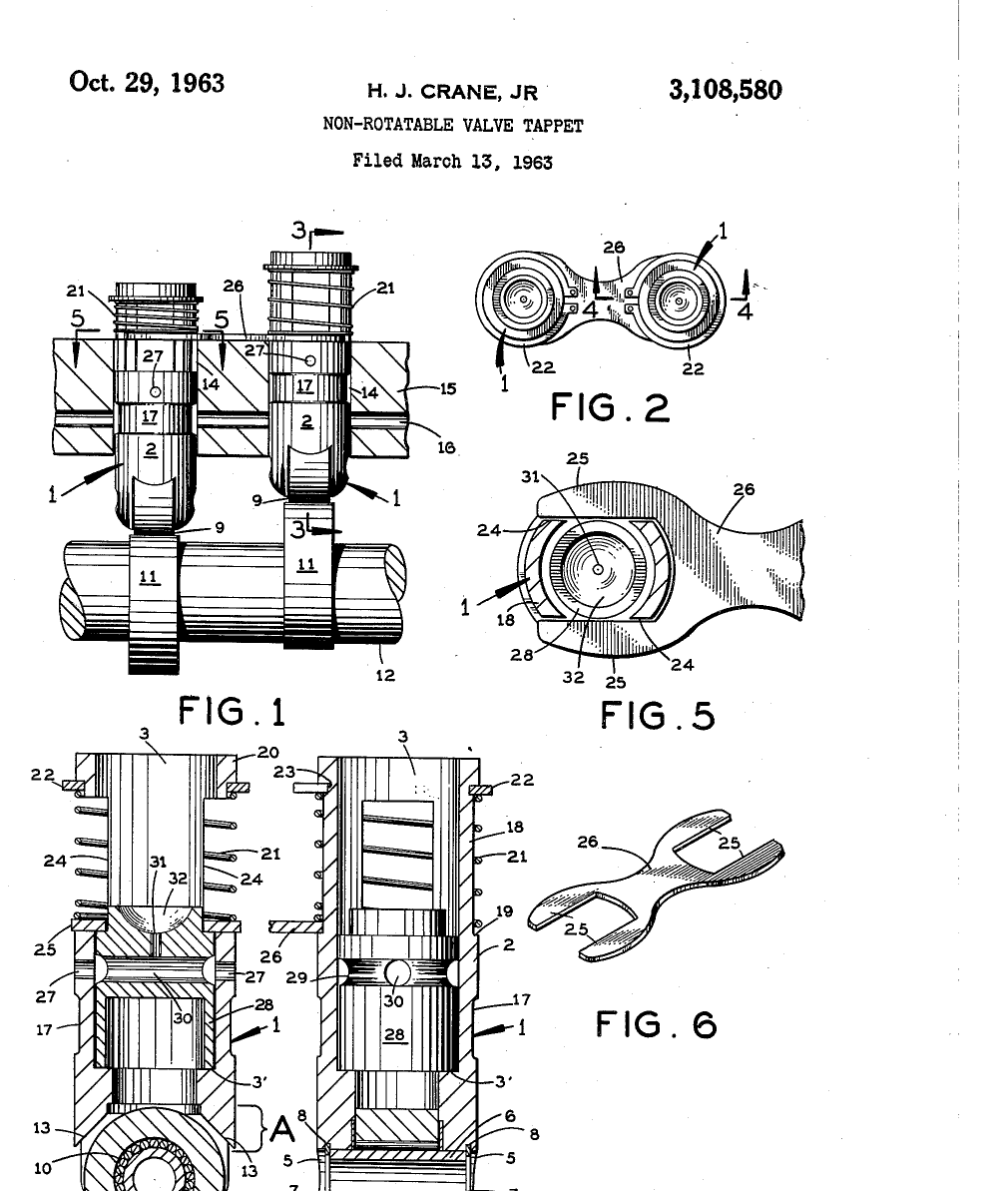
US 3,108,580, “Non-rotatable valve tappet,” sheet 1. Inventor: Harvey J. Crane Jr. Filed 1963-03-13, issued 1963-10-29. Source: Google Patents (drawing from the USPTO image). License: public domain (U.S. patent drawing).
The business grew fast. By the mid-1960s, SEMA and the funeral-home obituary say, Crane Cams had “caught and surpassed its competitors” to become the largest racing cam company in the industry. In 1966 he took what SEMA calls “the unprecedented step of rewarding the little-guy weekend racers who had supported him in his early days”. The step was a refund of the price of the Crane cam and kit to the winner of each class at the Nationals, which he thought built even more loyalty.32
The Ohio side of the archive already had this piece of the story. Ron Hassel, a Cleveland gasser racer, left Ohio in 1965 to become Crane Cams’ sales manager in South Florida, and he won B/Gas at the 1966 Nationals in a ’48 Anglia. Jim Hill, the racer-journalist who also wrote SEMA’s obituary, said in Hot Rod that “a class winner displaying all the correct decals could collect nearly $2,000” by 1969, and Hill adds that he “wrote all the hot copy for Harvey Crane.”◐ See The Ohio Gassers.6 Moroso, South Florida’s other big performance name, owned the Palm Beach raceway that appears in Hill’s Hassel photo.
SEMA counted him among its earliest members. In January 1967 about 100 aftermarket companies set up booths on the Club Level of Dodger Stadium for what was then just “the trade show,” and Crane, SEMA says, demonstrated his wares with a “hand-operated engine simulator.” The archive’s Dick Wells page gives the same show 98 booths.⚠4 The first SEMA show at Dodger Stadium, where Crane exhibited, is on that page.
He was an inventor, and SEMA lists his firsts: patenting the design for mechanical roller tappets; roller-tip rocker arms with needle-bearing fulcrums and gold anodizing; an extra-high-lift (0.669-in.) cam; the 1965 technique of measuring duration “at 50” so cams could be compared. SEMA says that in 1967 he drafted his first computerized cam design “using a timeshare computer and a program sent from Michigan through telephone lines.” His son David, in the Sentinel, says he “pioneered computer camshaft designs in the early to mid-’60s.”⚠ Whether that was 1967 or the early to mid-’60s is still open. The “Fireball” budget cams came in 1972.
Crane’s shop foreman Tom Woitesek left for Memphis in 1972 and became a founder of COMP Cams and RHS, and Cam Dynamics ended up with Crane Cams.
In 1980 Crane Cams built a new Daytona Beach facility. He was inducted into the SEMA Hall of Fame (1981, per SEMA News) and the East Coast Drag Racing Hall of Fame in Henderson, North Carolina (per SEMA’s obituary).34 In 1985 it closed the Hallandale plant, per SEMA and the funeral-home obituary. The Sentinel says “in the 1980s.”321 The accounts of 1989 do not agree. The funeral-home obituary says Crane “retired.” The Sentinel says he “left the company and started his own work.” SEMA says that “following a disagreement with his board of directors” he was “ousted as chairman” and “dismissed,” and that “he refused to remain quietly ‘retired.’”⚠213 Whether he retired, left, or was ousted is still open. Google’s “cited by” list for Crane’s patent includes a 1991 Crane Cams “Roller tappet” patent and a 1998 Competition Cams “Anti-rotation valve lifter guide apparatus” patent, so the idea ran from Isky’s 1958 lifter guide, through Crane in 1963, into the 1990s COMP and Crane designs. On that list is a 2004 roller-valve-lifter application by “Schubeck Joseph J”◐
At his Port Orange home he started a cam school, and more than 100 students from racing, automotive, industrial and marine work came; SEMA says many of the leading racing cam designers today are graduates.3 A Carolina cam-shop owner told the Sentinel: “He had an excellent reputation for integrity.”1 Crane died May 31, 2013, at 81, and the family asked that memorial gifts go to the Darrell Gwynn Foundation.342
He found the cam from California wasn’t accurately made, so he ground his own, and that was the company. In 1966 the little guys who had supported him got the price of the cam and kit back.
See also: The Web of Influence.
Open questions & disputed details
6 items
From the detective’s notebook: where the sources disagree, where we have only one, and what we are still looking for. Each item links back to its place in the story.
Disputed. Where was he born? The Sentinel says Ojus, “a small community in what is now Miami-Dade County,” where his father was a machinist. SEMA says Hallandale, as the Hallandale shop would suggest. SEMA and the funeral home give his birth date as August 17, 1931; the Sentinel says only 1931. All three say he was 81 when he died.132 ↩
Single source so far. Nearly $2,000 a class win? The figure is Jim Hill’s, and Hill says he wrote Crane’s ad copy, so he is an interested party.5 ↩
Disputed. How many booths at the first show? SEMA News says “about 100” companies set up at Dodger Stadium in January 1967;4 the sources on our Dick Wells page give 98 booths. The two are close, and “about 100” may simply round 98. Lead: the 1967 show program. ↩
Disputed. When did Crane start computer cam design? SEMA has his first computerized design in 1967, on a timeshare computer;4 his son, in the Sentinel, says “the early to mid-’60s.”1 ↩
Single source so far. Is the 2004 “Schubeck Joseph J” Lakewood’s founder? Only the patent listing gives the name; we have not tied it to Lakewood’s Joe Schubeck.7 ↩
Disputed. Did Crane retire, leave or get fired in 1989? The funeral-home obituary says he “retired”; the Sentinel, that he “left the company”; SEMA, that he was “ousted” after a disagreement with his board.213 ↩
Sources & notes
7 notes
-
“Harvey J. Crane Jr.: His exacting work boosted race cars’ power,” Orlando Sentinel, Jun 20, 2013 (updated Nov 3, 2021). https://www.orlandosentinel.com/2013/06/20/harvey-j-crane-jr-his-exacting-work-boosted-race-cars-power/ (accessed 2026-10-16) ↩↩↩↩↩↩↩↩↩↩
-
“Harvey J. Crane Obituary,” Lohman Funeral Homes, May 31, 2013. https://obituaries.lohmanfuneralhomes.com/obituaries/harvey-crane (accessed 2026-10-16) ↩↩↩↩↩↩↩
-
Jim Hill, “Racing Industry Pioneer Harvey Crane Passes Away,” SEMA eNews, 2013. https://www.sema.org/news-media/enews/2013/23/racing-industry-pioneer-harvey-crane-passes-away (accessed 2026-10-16) ↩↩↩↩↩↩↩↩↩↩↩↩
-
Drew Hardin, “Crane’s First SEMA Show,” SEMA News, Nov 2013. https://www.sema.org/news-media/magazine/2013/44/cranes-first-sema-show (accessed 2026-10-16) ↩↩↩↩↩↩
-
Jim Hill, “Sportsman Racers Winning Class at Indy Was Their High Mark,” Hot Rod, Nov 23, 2015, as summarized on The Ohio Gassers. https://www.hotrod.com/news/sportsman-racers-winning-class-at-indy-was-their-high-mark (accessed 2026-10-15) ↩
-
See The Ohio Gassers (Hill, East Coast Drag Times Hall of Fame, 2016). ↩
-
US 3,108,580A, “Non-rotatable valve tappet” (Harvey J. Crane Jr.), Google Patents, incl. its “Patent citations” and “Cited by” lists, which Google generates by computer. https://patents.google.com/patent/US3108580A/en (accessed 2026-10-16) ↩