Drag Racing & Strips 1950s Montana, Washington Grassroots
“Angels Behind the Wheel”: Montana’s Hoodoos, Road Runners and Royal Coachmen (Poplar, Arlee and Ronan, Mont., 1955–62)
In 1955 the Hoodoos of Poplar said a skull-and-crossbones emblem was a warning to drive carefully, and the weeklies kept printing clubs that asked to be trusted. By July 1962 LeRoy Morin had won his 20th trophy of the season in the family car.
Confidence MediumHow we know this
- Confidence
- Medium
- Source types
- Grassroots Montana weeklies (Poplar Standard, Sidney Herald, Hardin Tribune-Herald, St. Ignatius Post), 1955–62: club statements, a club's letter to the editor, a reprinted editorial and a local racing item, read as page OCR from Chronicling America (Library of Congress)
- Last verified
- 2026-11-03 (Round 31: Lewistown, Belgrade and Glendive from North Dakota sources)
- Open issues
- the Morin trophy count and times come from one paragraph ◐; the Lewistown meet is known only from a reprinted editorial ◐; whether the Hoodoos, Throttle Pushers and Royal Coachmen lasted past their first year ?
Clubs explaining themselves in the weeklies, from a skull emblem in 1955 to a 20th trophy in the family car in 1962
In their own words
“We are not gang of tough guys, and don’t pretend to be.”
— The Hoodoos Hot Rod Club of Poplar, Mont., in the Poplar Standard, Dec. 30, 1955.1
Montana’s small weeklies did not cover drag racing much in the 1950s. What they did print, again and again, was hot rod clubs explaining themselves. From Poplar, whose weekly called itself “Voice of The Oil City,” to Sidney, Hardin, Arlee, Ronan and St. Ignatius, young men wrote down their rules and sent them to the paper.1 First the clubs asked to be trusted. Then the town argued. By 1962 one club president was winning trophies in the family car.
The skull and the calling card (1955–59)
In December 1955 the front page of the Poplar Standard told readers not to be alarmed if a young man in a black leather jacket with a skull and crossbones on it stopped at their stalled car. “The emblem is that of the Poplar Hoodoos Hot Rod club, and the wearer is there to help you.” The emblem had caused misunderstandings, the club said, but its meaning was a question: “Are you a careful driver, or will you end up like this?” Each member carried a card to hand to the motorists he helped: “U were assisted by a member of the Hoodoo’s Hot Rod Club, Poplar, Montana.” The Hoodoos belonged to the National Hot Rod Association, and their rules were strict. A member fined for a traffic violation paid the same fine again to the club and was suspended for 30 days or more, and drinking and driving meant immediate suspension. A new member served 60 days on probation, every member had to pass a first-aid test, and every member’s car carried a first-aid kit and a fire extinguisher. President Gene Bauer said people were “too quick to judge,” and gave the club motto as “Angels behind the wheel.”1 The double fine was a rule other clubs used too; see the Drag-Ons of Sedalia.
The next spring, in Hardin, Roger Shaw’s youth council column raised the “controversial” subject of a drag strip, which he described as “not a race track but rather a straight, flat strip about three blocks long.” He argued that a strip would keep fast driving off the streets and pointed to Billings, where “the hot rod clubs cooperate with the authorities.”2 At the end of May the council’s tally of sign-ups for its summer program showed five people asking for a drag strip.4 A week later the column summarized the council’s poll of Hardin High School: of 315 questionnaires returned, 72 students listed a drag strip among the summer activities they wanted.3 Two years later, in Sidney, a group of boys aged 14 to 18 organized the Throttle Pushers, about eight members who wanted their club “under the supervision of adults” and fined any member who broke a traffic law.5
The strips that did exist could bring trouble with them. In May 1959 the Glasgow Courier wrote that Lewistown was “recovering from a wild melee” after “camp followers of the worst kind” came to town for “an authorized drag race program.” The editorial said the meet itself was “well run and orderly,” and it quoted a spokesman for the local Road-Stur Club: “There was no way we could handle the rough element.” The Poplar Standard reprinted the editorial a week later.6◐ We know the meet only from the editorial as reprinted in Poplar.
Montana’s strips also served North Dakotans next door. Bruce Olson of Beach, North Dakota, a Montana border town, “ran the Coupe at both the Lewistown & Bozeman (Belgrade) Air/Drag Strips (circa 1958),” his son wrote; the Bozeman strip, by that account, was the airport at Belgrade.12 (Full story: North Dakota’s borrowed strips.)
Arlee and Ronan (1960–62)
In February 1960 the secretary, Francis “Frenchy” Budland, and the president, LeRoy Morin, of the Road Runners Rod and Kustom club at Arlee sent the St. Ignatius Post a statement because “a good deal of misunderstanding exists as to the objectives of a Hot Rod club.” Its rules would have suited the Hoodoos. Members who broke the law were fined or expelled, there was no alcohol at club events, and every member’s car had a safety check every three months. Rule two read: “Any racing of any kind is limited to sanctioned and insured Drag Strips.” The club promised to help stalled motorists and support safety and charity drives, and it gave NHRA’s size as “over 90,000 members” in “over 900 chartered clubs.”7
The next winter it was the turn of the Royal Coachmen Car Club of Ronan. The club held a dance at the Ronan parish hall on Dec. 23, 1961.8 A month later its president, Ronald McCrea, wrote to the Post asking the public for “a chance to prove ourselves.” The Coachmen ranged in age from 16 to 24 and were a charter member of NHRA, and the club said it worked “hand in hand with law enforcement agencies.” It had been “criticized many times because of the actions of someone who didn’t belong to the club.” So the letter printed every member’s name and asked readers to report any of them seen breaking the law. The list included women. Lonna Stevens was vice president and Judy Compton secretary, and Bud Hughes was named as sponsor.9 The same paper had printed a sterner view the summer before, a column asking young readers whether they would pay “homage to the hot rod artist who ought to be in jail and soon will be, or dead.”10
By the summer of 1962 the Road Runners’ president was racing as far away as Deer Park, Washington. On July 26 the Post’s Arlee correspondent reported that Mr. and Mrs. LeRoy Morin and their two children, ages 6 and 4, were going to Deer Park again that weekend, where Morin would race “for a $100 purse,” at the strip in Deer Park, Washington. At the last Deer Park meet he had won his 20th trophy since April 1, and his wife had won her sixth in the “Powder Puff Woman’s race.” She drove her husband’s car, a C/Gas entry described as “an older type body with a newer engine.” The Morin racer was also the family car: they drove it to the races, it had covered 89,000 miles, and only the Morins drove it. Morin had first raced in 1958 at Butte, where he won “in 16.2 second at 85 miles per hour.” His latest win was 14.26 seconds at 100 mph. Six more meets were planned that year, at Deer Park, Butte, Bozeman and Conrad. Morin said the association’s safety standards would “disqualify about 50 per cent of the cars on the highway.”11◐
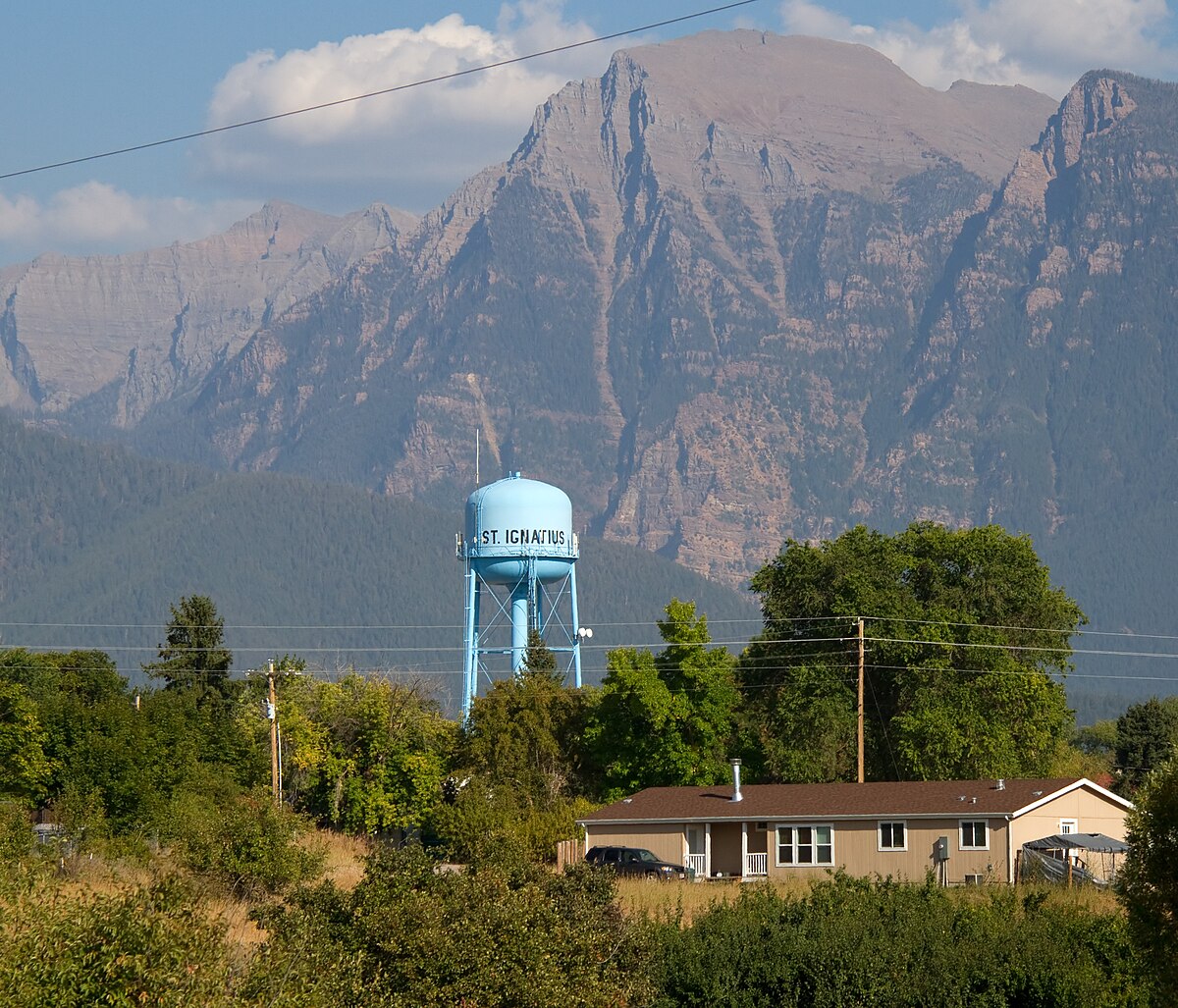
St. Ignatius, home of the weekly that printed the Arlee and Ronan clubs’ statements. Creator: Tony Hisgett. Date: 2012-09-16. Source: Wikimedia Commons. License: CC BY 2.0.

Clubs elsewhere in the archive wrote the same kind of statements: the Orchids and Celtics of Canyon, Texas and the Twin Falls club that formed to get off Main Avenue. In Montana the clubs first explained a skull emblem, then printed their members’ names, and by 1962 one club’s president was driving the family car to Deer Park and winning.?
Glendive (late 1970s)
Later a North Dakota racer, Hank Berry, drove 55 miles to a drag strip at Glendive until it closed in the late 1970s.13
See also: another far-northern strip hunt in the same years, Palmer, Alaska, and Polar Dragway. Next door, Wyoming’s hot rodders raced on an old airport’s runways: see Casper and Wyoming’s strips.
Open questions & disputed details
3 items
From the detective’s notebook: where the sources disagree, where we have only one, and what we are still looking for. Each item links back to its place in the story.
Single source so far. What happened at Lewistown in 1959? We know the meet only from the Glasgow Courier editorial as reprinted in Poplar. It names the Road-Stur Club but gives no date, place, sanction or arrest count for the “melee.”6 ↩
Single source so far. Are the Morin numbers right? The trophy count, the 89,000 miles and both times come from one correspondent’s paragraph, which also mentions a Missoulian feature on the family that we have not found. The paper prints the boy’s name as “Thomothy.”11 ↩
Open question. Did the Hoodoos, Throttle Pushers or Royal Coachmen last past their first year? We know the Hoodoos from one 1955 statement, the Throttle Pushers from one 1958 report and the Royal Coachmen from the winter of 1961–62; only the Road Runners still turn up, with Morin as president, in 1962.15911 Chronicling America’s Montana weeklies stop at 1963. ↩
Next leads
The Missoulian feature on the Morins (summer 1962); where Montana’s 1958–62 strips were at Butte, Bozeman and Conrad, and who ran them; the Lewistown meet in the Lewistown Daily News (May 1959); later Montana papers, after 1963, for the Hoodoos, Throttle Pushers and Royal Coachmen.
Sources
13 notes
-
“Hoodoos Hot Rod Club Defends Name,” Poplar Standard (Poplar, Mont.), Dec. 30, 1955, p. 1. Page OCR via Chronicling America, Library of Congress. https://www.loc.gov/resource/sn86075284/1955-12-30/ed-1/?sp=1 (accessed 2026-10-22) ↩↩↩↩
-
Roger Shaw, “Youth Council Corner,” Hardin Tribune-Herald (Hardin, Mont.), Apr. 5, 1956, p. 11. Page OCR via Chronicling America. https://www.loc.gov/resource/sn86075229/1956-04-05/ed-1/?sp=11 (accessed 2026-10-22) ↩
-
Roger Shaw, “Youth Council Corner” (poll summary), Hardin Tribune-Herald, June 7, 1956, p. 4. Page OCR via Chronicling America. https://www.loc.gov/resource/sn86075229/1956-06-07/ed-1/?sp=4 (accessed 2026-10-22) ↩
-
Summer recreation sign-ups, Hardin Tribune-Herald, May 31, 1956, p. 4. Page OCR via Chronicling America. https://www.loc.gov/resource/sn86075229/1956-05-31/ed-1/?sp=4 (accessed 2026-10-22) ↩
-
“Sidney Boys Organize ‘Throttle Pushers’ Club,” Sidney Herald (Sidney, Mont.), Nov. 12, 1958, p. 7. Page OCR via Chronicling America. https://www.loc.gov/resource/sn83004278/1958-11-12/ed-1/?sp=7 (accessed 2026-10-22) ↩↩
-
“Only One Way to Handle ‘Punks’,” reprinted from the Glasgow Courier of May 14, 1959, Poplar Standard, May 22, 1959, p. 6. Page OCR via Chronicling America. https://www.loc.gov/resource/sn86075284/1959-05-22/ed-1/?sp=6 (accessed 2026-10-22) ↩↩
-
“Aims of ‘Hot Rod’ Clubs Explained by Local Club Officials,” St. Ignatius Post (St. Ignatius, Mont.), Feb. 18, 1960, p. 3. Page OCR via Chronicling America. https://www.loc.gov/resource/sn84036106/1960-02-18/ed-1/?sp=3 (accessed 2026-10-22) ↩
-
Royal Coachmen dance notice, St. Ignatius Post, Dec. 14, 1961, p. 2. Page OCR via Chronicling America. https://www.loc.gov/resource/sn84036106/1961-12-14/ed-1/?sp=2 (accessed 2026-10-22) ↩
-
Ronald McCrea, “Hot Rod Club Seeks Support of Public,” letter, St. Ignatius Post, Jan. 25, 1962, p. 3. Page OCR via Chronicling America. https://www.loc.gov/resource/sn84036106/1962-01-25/ed-1/?sp=3 (accessed 2026-10-22) ↩↩
-
Column addressed to teenage readers, St. Ignatius Post, Aug. 3, 1961, p. 3. Page OCR via Chronicling America. https://www.loc.gov/resource/sn84036106/1961-08-03/ed-1/?sp=3 (accessed 2026-10-22) ↩
-
“Morins Seek More Trophies,” Arlee news, St. Ignatius Post, July 26, 1962, p. 8. Page OCR checked against the page image, via Chronicling America. https://www.loc.gov/resource/sn84036106/1962-07-26/ed-1/?sp=8 (accessed 2026-10-22) ↩↩↩
-
HEMI32 (Todd Olson), post #13, July 28, 2010, in “Lewistown, Montana... Drag Racing in 1959,” The H.A.M.B. https://www.jalopyjournal.com/forum/threads/lewistown-montana-drag-racing-in-1959.497100/ (accessed 2026-11-03) ↩
-
“Nodak Hall of Fame: Inductees” (‘Smokin’ Hank Berry), Nodak Race Club, Internet Archive copy of Jan. 14, 2025. https://web.archive.org/web/20250114053533/https://racenodak.com/hall-of-fame/hof-inductees/ (accessed 2026-11-03) ↩