People & Builders 1960s North Carolina, Maryland
Malcolm Durham: Strip Blazer
Malcolm Durham learned mechanics on tractors in Goldsboro, N.C., raced from 1957, and ran Strip Blazer cars from a 409 Chevy to a Logghe-chassised Funny Car. He averaged $800 per appearance in the late 1960s.
Confidence MediumHow we know this
- Confidence
- Medium
- Source types
- NHRA Top 50 profile (2001), NHRA.com Fred Files quote (2009)
- Last verified
- 2026-10-14 (Round 9)
- Open issues
- Full oral history still thin; Top 50 rank listed as 48 vs 46 in later column
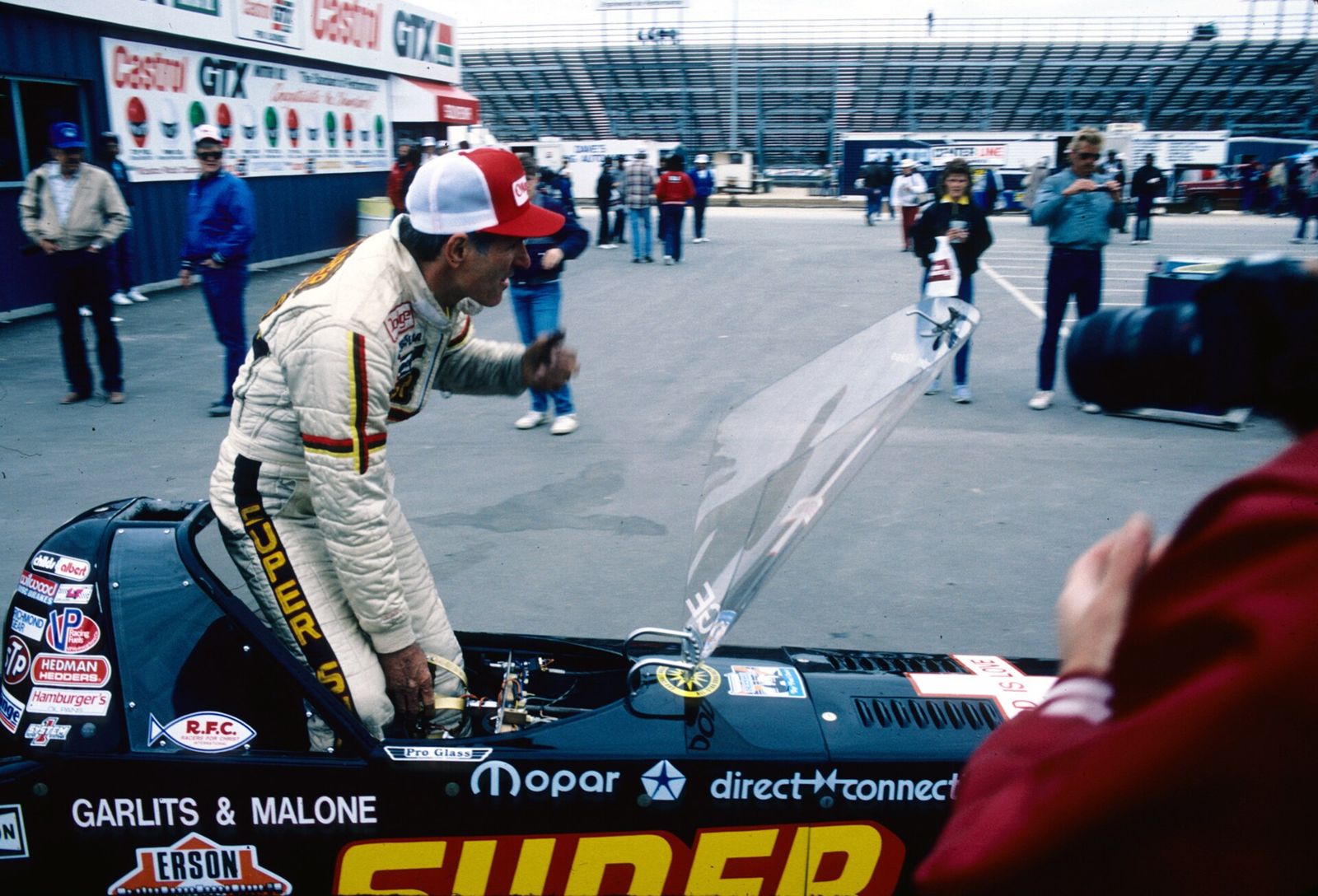
Don Garlits, Texas Motorplex, April 1987. Durham's Strip Blazer Funny Cars were East Coast match-race fixtures in the late 1960s on the same national nitro scene. Creator: twm1340. Source: Wikimedia Commons. License: CC BY-SA 2.0.

From tractors in Goldsboro and a 1957 start at Easy Street to the Strip Blazer, at $800 per appearance
In their own words
“We encountered some problems in the South because those people didn’t want to accept us. But for me, being black was actually a plus because it made me unique, and I tried to capitalize on it as much as possible. During the late 1960s, I averaged $800 per appearance, and that made me one of the highest paid drivers in the business.”
— Malcolm Durham, quoted by Phil Burgess, NHRA.com, July 31, 2009. Voices
Malcolm Durham learned mechanics on tractors, on the family farm in Goldsboro, N.C.1 He began racing in 1957 at Easy Street Dragstrip, Newton Grove, N.C., in a 225-hp ’56 Chevy.1 He ran Strip Blazer cars. He said being black made him unique, and he tried to capitalize on it. In the late 1960s he averaged $800 per appearance. NHRA ranked him among its Top 50 Drivers in 2001.12
He moved to Washington, D.C., where he took trade-school auto courses and ran the ’56 with success at Aquasco Speedway (Md.).1
Hicks Chevrolet had him as a mechanic in 1962, and he campaigned a 409 ’62 Chevy with Z-11 heads; the Top 50 text says he won nearly 90% of races entered.◐1 He moved into car sales and ran the first 427 Z-11 ’63 Chevy available in D.C. as Strip Blazer I. Its first outing at 75-80 Drag-A-Way improved on his 409 best (12.26 → 12.01 per Top 50).◐1
Match races on the East Coast circuit put him against Don Nicholson, Sox & Martin, the Ramchargers, Hayden Proffitt, Dave Strickler, Bill Jenkins, and others.1 After Chevrolet withdrew from racing (end of 1963), he put the Z-11 into a midsize ’64 Chevelle (Strip Blazer II) and, in match races that year, beat Sox & Martin multiple times.1
In 1965 he updated the Chevelle sheetmetal, injectors and nitro; Top 50 cites bests of 9.56 / 150 mph.◐1 1966 brought a tube-frame Camaro and a UDRA Nationals win at U.S. 30, then a wheelbase stretch into the eights.1
In 1967 he added a supercharger and ran 7.98 / 178, and in the off-season came a new Logghe-chassised Camaro from Logghe, one of his best rides, with regular 7.5s in 1968; he broke 200 mph in 1969 per Top 50.◐1
A Pro Stock ’73 Vega (9.17 best cited) and a conversion to B/EA came later, and he paused racing to send his eldest son, Bernard, to college, came back with a brief 1984 Pro Stock Camaro that he crashed at Rockingham in 1985, and returned in 1989 with a nostalgia ’65 Chevelle.1
Burgess’s 2009 “Fred Files” column quotes Durham on Southern hostility and on using visibility as a booking advantage ($800 average appearance fees in the late 1960s). The same column notes he inspired other Black Funny Car racers including Lee Jones (later drove Strip Blazer floppers for Durham) and mentions Western Bunns’s Soul Twister cars as part of that East Coast scene.2⚠ Whether the Top 50 slot was No. 46 or No. 48, the sources disagree.
The tractors were in Goldsboro. The Strip Blazer cars ran from that 1957 start, and he tried to capitalize on being black.
See also: Logghe Stamping, Leonard Miller, Midwest & East, Injection & Tin voices.
Open questions & disputed details
5 items
From the detective’s notebook: where the sources disagree, where we have only one, and what we are still looking for. Each item links back to its place in the story.
Single source so far. Nearly 90% wins? The 1962 record with the 409 comes only from NHRA’s Top 50 text.1 ↩
Single source so far. 12.26 to 12.01? The Strip Blazer I times come only from NHRA’s Top 50 text.1 ↩
Single source so far. 9.56 / 150 in 1965? The Chevelle’s best times come only from NHRA’s Top 50 text.1 ↩
Single source so far. Regular 7.5s and 200 mph? The Logghe Camaro’s 1968 times and the 1969 200 mph come only from NHRA’s Top 50 text.1 Lead: Drag News, 1968–69. ↩
Disputed. No. 46 or No. 48? Burgess’s 2009 column calls his Top 50 slot No. 46; the 2001 Auto Channel reprint of the NHRA text is headed Number 48.21 We flag it until the original National Dragster list is checked. ↩
Visual references (external)
- NHRA, “The Final Fred Files” (Durham Strip Blazer photo by Fred von Sholly)
- Auto Channel reprint, NHRA Top 50: Malcolm Durham
Sources & notes
2 notes
-
Anthony Vestal / NHRA, “NHRA 50 Greatest Drivers: Malcolm Durham, Number 48,” The Auto Channel, Feb 9, 2001. https://www.theautochannel.com/news/2001/02/09/014436.html (accessed 2026-10-14) ↩↩↩↩↩↩↩↩↩↩↩↩↩↩↩↩↩
-
Phil Burgess, “The Final Fred Files,” NHRA.com, July 31, 2009. https://www.nhra.com/news/2009/final-fred-files (accessed 2026-10-14) ↩↩↩