People & Builders 1960s Ohio
“Fast Eddie” Schartman: Taking Out the Finish-Line Lights
On his first pass in a Logghe flip-top Comet in December 1965, Eddie Schartman went 166 mph and took out the finish-line lights, then won NHRA's first Funny Car eliminator in 1966.
Confidence MediumHow we know this
- Confidence
- Medium
- Source types
- oral (2016 interview), secondary
- Last verified
- 2026-10-13 (Round 4)
- Open issues
- Self-reported firsts flagged
- Principal source
- Phil Burgess's 2016 interview with Schartman, then 78, in National Dragster/NHRA.com.1 This is first-person oral history.
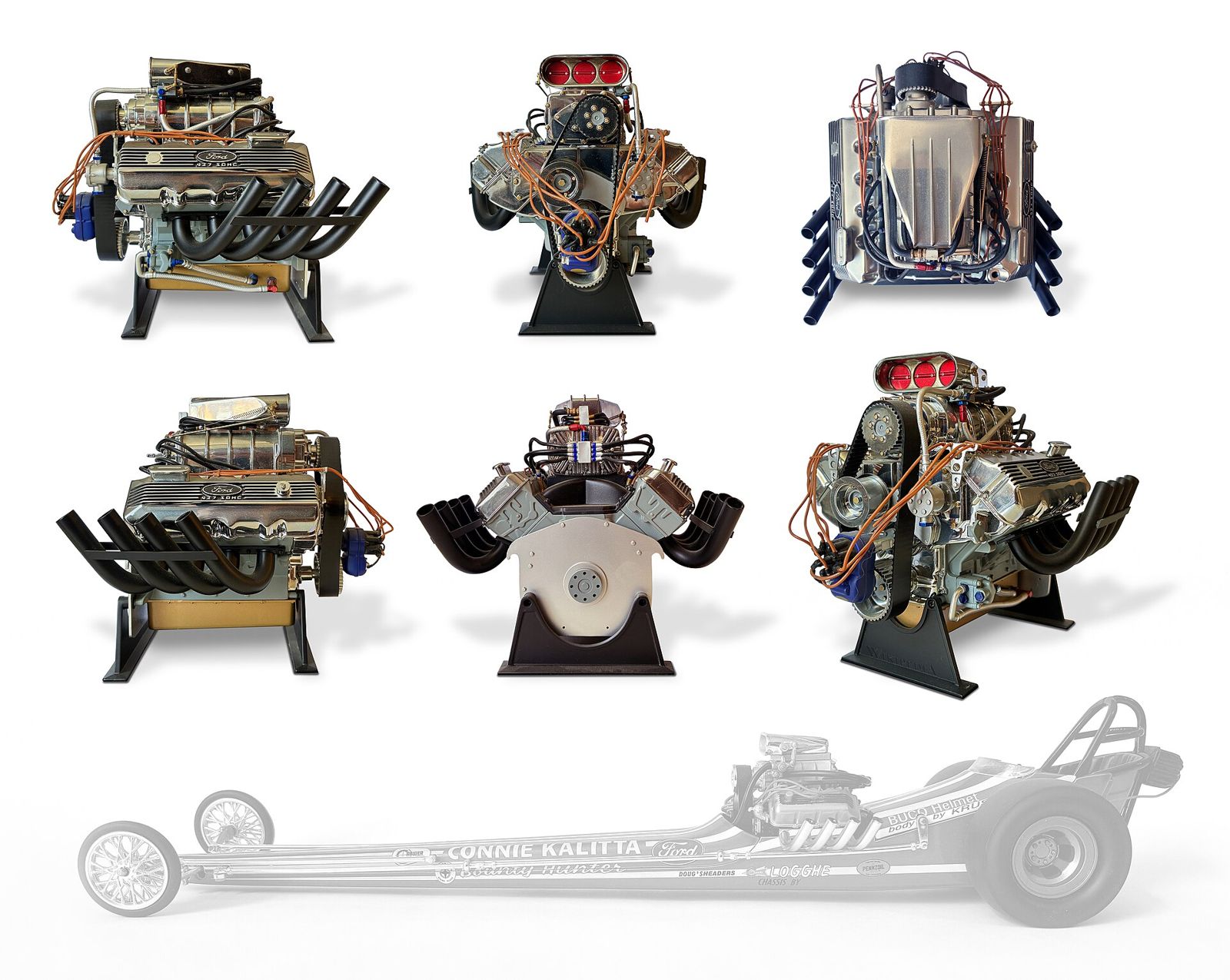
A Top Fuel display engine based on the Ford 427 SOHC. Schartman's 1966 flip-top Comet ran an injected 427 SOHC (it was not supercharged until 1967). This is a modern blown example, not his engine. Creator: Auge=mit. Date: 2025-06-22. Source: Wikimedia Commons. License: CC BY-SA 4.0.

On his first pass in a flip-top Comet he went 166 mph and took out the finish-line lights
In their own words
“On my first pass, I went 166 mph and took out the [finish-line] lights.”
— Eddie Schartman, NHRA.com, 2016. Full context in Voices
On his first pass in a flip-top Comet, Eddie Schartman went 166 mph and took out the finish-line lights. He had come out of a Cleveland wrecking yard. At the 1966 World Finals in Tulsa he won NHRA’s first Funny Car eliminator.
He started young. His father, Ed Sr., raced dirt tracks, and the family owned a wrecking yard. Eddie built a flathead ’40 Ford drag car at 14. He finished Berea High School in 1956 and drove a street ’56 Chevy (338 ci) to Daytona Speed Week, where he “won everything in sight.” He then set the NHRA B/Gas record in a ’55 Chevy.1 He was one of the “Ohio Gassers” (see Mr. Gasket).
The road to the Comet ran through a Chevy dealer. He worked at Jackshaw Chevrolet in Cleveland. In 1964 he moved to Atlanta to build engines for “Dyno Don” Nicholson. He drove Nicholson’s ’62 Chevy for 50 percent of the winnings, then got the A/FX Comet wagon “The Ugly Duckling.” Mercury later gave him his own Comet and $5,000 from Cleveland-area Mercury dealers.1
The flip-top Comet
His first ride came in December 1965 at Motor City Dragway. “I said, ‘What the hell is this?’ It was a dragster with a body on it and the driver in the back seat... On my first pass, I went 166 mph and took out the [finish-line] lights.”1
It was a new kind of car. It had a Logghe chromoly chassis with a 116-in. wheelbase. Al Turner said they were the first drag car with coil-over shocks. The bodies came from Plastigage of Jackson, Mich., and the hinged “flopper” idea is credited to Ron Logghe (per John Logghe). Al Bergler did the tin work.1◐
Within a year it was a winner. At the 1966 World Finals in Tulsa he beat Nicholson (8.38/174.08) for NHRA’s first Funny Car eliminator win.1
In 1967 came Air Lift sponsorship, with “Famous Amos” Satterlee as crew chief. He claimed the first seven-second run in a stock-bodied car at Detroit Dragway in April, though he “doesn’t put a lot of stock” in such firsts.1
That season also produced his claim to an accidental rear spoiler, from Maple Grove in 1967: angle iron bolted to the trunk. “It went straight and picked up 5 mph. We’d invented the [rear-deck] spoiler and didn’t even know it.”1◐
In Pro Stock, the 1972 Gatornationals tech crew disqualified his Maverick because it had Mercury Comet taillights. He quit match racing in 1975 over rainouts (“The rainout money was like $150”) and went into car dealerships and NAPA stores. He was inducted into IDRHOF in 2012.1
The first pass, in December 1965, went 166 mph and took out the finish-line lights. The 1966 World Finals was NHRA’s first Funny Car eliminator win.
See also: The Ohio Gassers (his Cleveland circle) and Houston Freeway (Roy Gay was runner-up to Schartman at the 1967 Manufacturers Championships).
Open questions & disputed details
2 items
From the detective’s notebook: where the sources disagree, where we have only one, and what we are still looking for. Each item links back to its place in the story.
Single source so far. Who designed the Comet’s parts? The Plastigage, Logghe and Bergler credits are attributions within one NHRA article.1 ↩
Single source so far. Did Schartman invent the rear spoiler? It is his own “first,” self-reported to NHRA.1 ↩
Visual references (external)
These are copyrighted or rights-restricted images, so we link to them instead of copying them.