Companies & Shops 1900s Pennsylvania, New York
Holley: A Bicycle Motor from Bradford and the Carburetor That Followed Everybody
At the 1901 Pan-American Exposition in Buffalo, George Holley raced a motor bicycle he had designed. The Bradford brothers' company went from that bicycle motor to the carburetor that followed the cars, the war, and the aftermarket.
Confidence MediumHow we know this
- Confidence
- Medium
- Source types
- state historical marker essay (Pennsylvania Historical and Museum Commission, 2008), university heritage feature built with the company foundation's help (Penn State, 2010–11), a 1916 trade-journal ad, company brand pages, SEMA Hall of Fame
- Last verified
- 2026-10-16 (Round 15)
- Open issues
- ⚠ 1901 vs 1903 for the carburetor licence; ⚠ "almost half" vs "more than half" of WWII carburetors; ⚠ when Holley bought Hooker (1990s vs 2000); the Holley Foundation history pages returned 404
- Note
- stronger for the Bradford years than for the aftermarket years
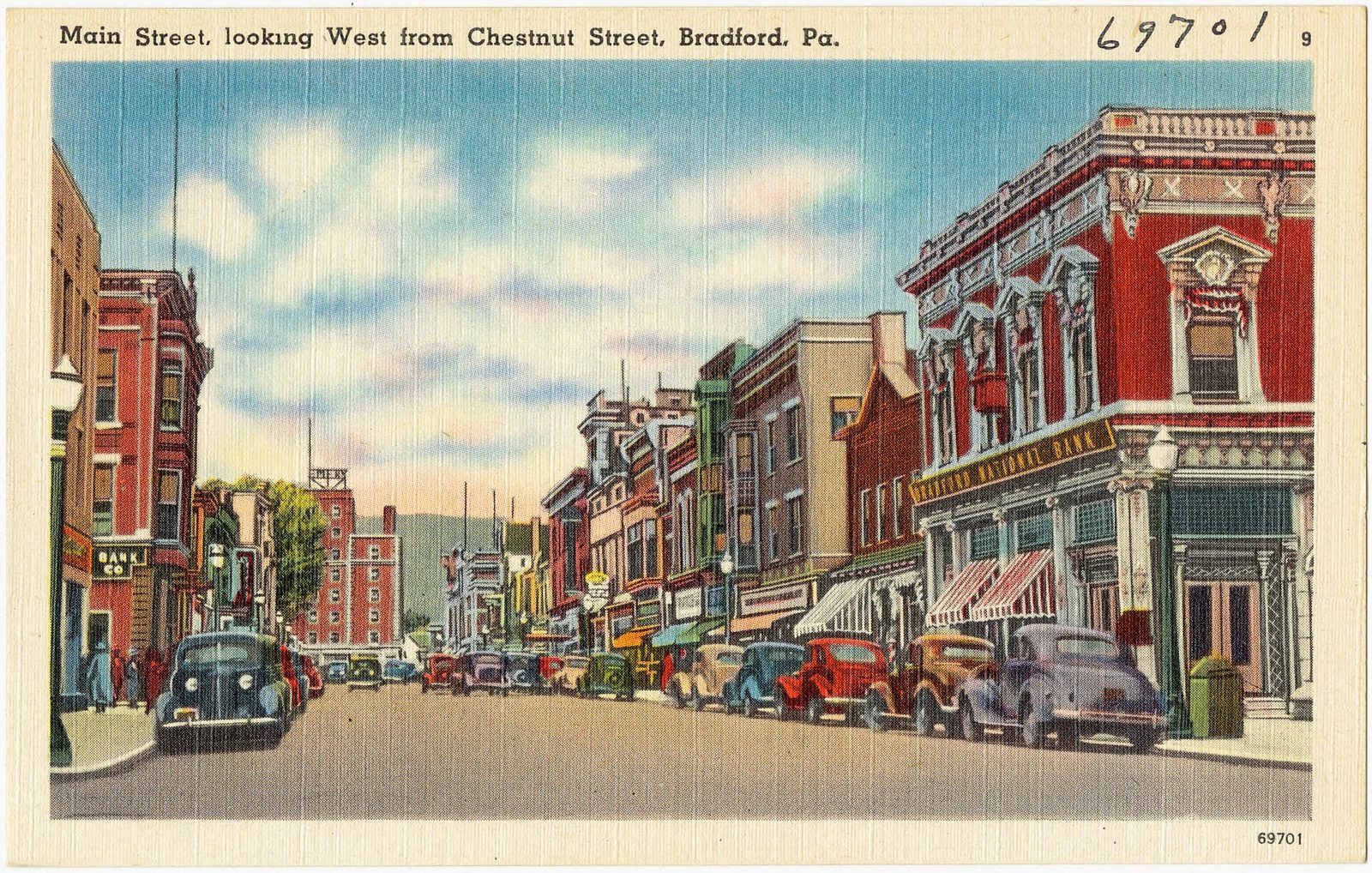
Main Street, looking west from Chestnut Street, Bradford, Pa. Linen postcard, c. 1930–1945 (Tichnor Bros., Boston, for the Bradford News Co.). Later than the Holleys' years there; context only. Source: Wikimedia Commons. License: public domain.

A motor bicycle from Bradford, raced at Buffalo in 1901, and the carburetor company that followed
On a summer day in 1901 at the Pan-American Exposition in Buffalo, twenty-three-year-old George Holley was out to break the world five-mile record on a motor bicycle he had designed. Holley is the company that started with that bicycle. The carburetor followed the cars, the war, and the brands. One attempt is in the August 22, 1901, McKean County Miner, as quoted by the Pennsylvania marker essay: Holley “lost control of his whirling engine close at the finish and went bounding off the board platter. The only damage was a stir up of the officials. Holley never lost presence of mind nor attempted to dismount, but shut off the power and continued the trip over sod.” He broke “all existing marks for five miles” that day.1
Holley came to Buffalo from Bradford, Pennsylvania, an oil boomtown in McKean County. His father Frank ran the Holley House there, a four-story, 70-room hotel. The marker essay says the boomtown culture “spawned a host of refiners, dealers, brokers, and others all seeking to ‘strike it rich’,” and that in that “fertile environment for entrepreneurial innovation” George and his brother Earl, “natural-born mechanics and tinkerers,” did the rest.1
Bicycles were the start. In 1896 George attached a motor to a bicycle, making the motor “an integral part of the bike frame.” In 1897, he was nineteen and Earl sixteen, and they built a three-wheeled single-cylinder car they called the Runabout, which hit thirty miles an hour. They formed the Holley Motor Company two years later, Earl on administration and George on engineering, building engines on Davis Street and then whole motorcycles “in response to customer demand.” George raced them to promote the business. In July 1902 he won the first Motorcycle Endurance Contest, Boston to New York.1 Whether the French carburetor licence was 1901 or 1903 is still open.⚠
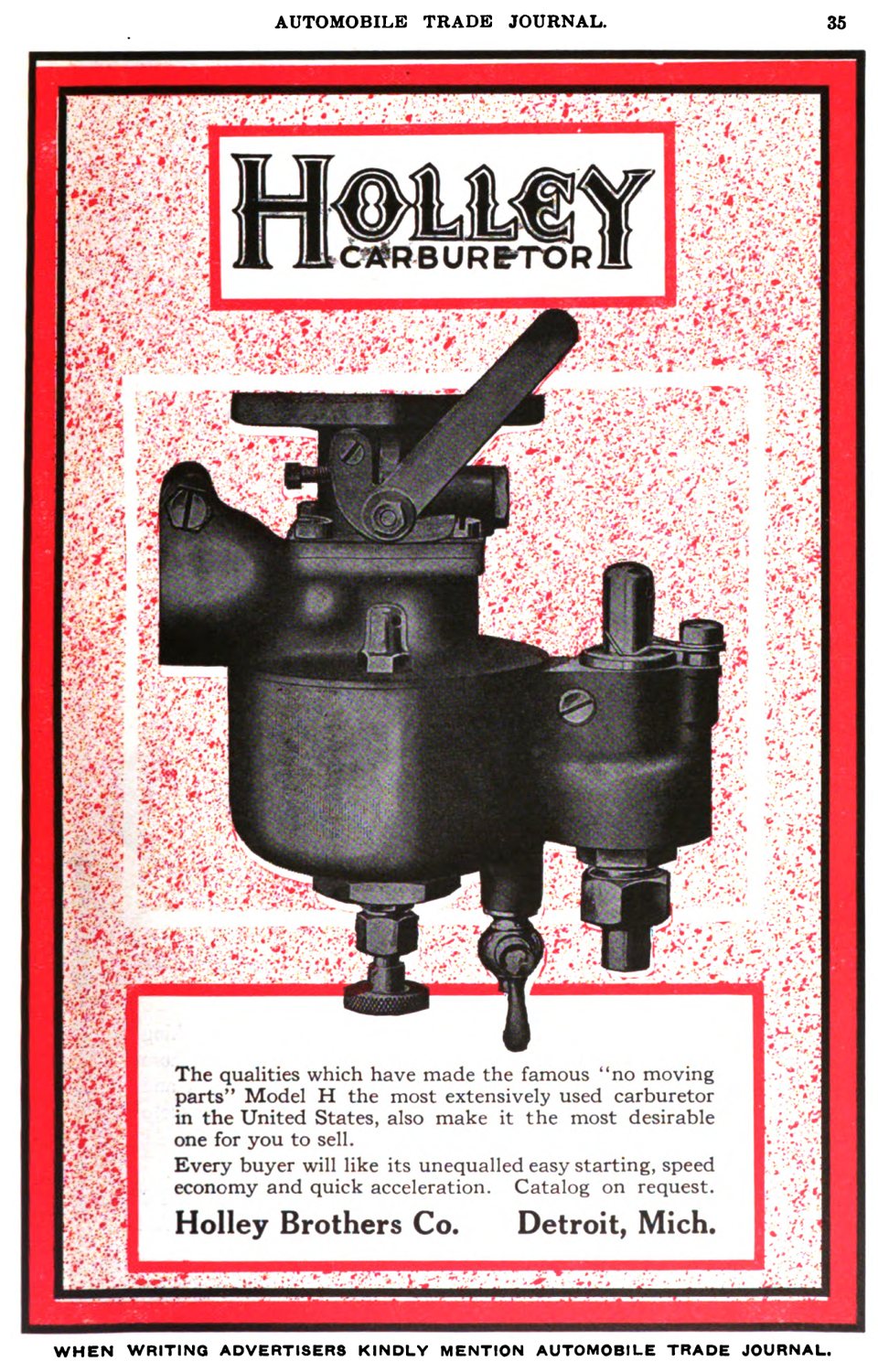
Holley Brothers Co. advertisement for the Model H carburetor, Automobile Trade Journal, vol. 20, 1916, p. 35. The ad claims “no moving parts” and calls the Model H “the most extensively used carburetor in the United States.” That is advertising copy. Creator: Holley Brothers Company. Date: 1916. Source: Wikimedia Commons. License: public domain.

The business followed the car industry. In 1907 the brothers moved their headquarters to Detroit and opened their first plant there late that year. In 1917 they sold Ford the car-carburetor business and refocused on tractors, selling to International Harvester and Chevrolet as the Holley Carburetor Company. Aviation followed in 1927. During World War II, the marker says, “almost half the vehicles in the U.S. armed forces had a Holley carburetor and fuel-metering device.” Penn State says “more than half” of all the carburetors and carburetion devices used in the war carried the Holley trademark, and adds Holley fuel-metering on the B-25s of the Doolittle raid.⚠
What hot rodders know begins in 1948, when Holley “entered the automotive aftermarket, supplying service stations and garages with Holley carburetor repair kits and parts,” and added plants in Tennessee and Kentucky. Headquarters moved to Warren, Michigan, in 1951, with a 250,000-square-foot plant at Bowling Green, Kentucky. The 1968 merger with Colt Industries, a 1979 replacement-parts division, and the 1994 sale of the original-equipment division to Borg-Warner follow in the marker’s chronology.1
Penn State calls Holley “the first American company dedicated to designing performance carburetors”◐
In the 1990s the marker says Holley “expanded to include Hooker Headers, Flowtech Exhaust, Earl’s Performance Plumbing, and NOS.” SEMA’s Hall of Fame profile of Hooker’s founder says Gary Hooker “sold Hooker Headers to Holley Performance Products in 2000.”⚠ Whether that was the 1990s or 2000 is still open. Hooker Headers, Gary Hooker’s header shop, has been a Holley brand since 2000 (or earlier, per the marker); the sale date is a⚠ conflict.
Holley’s brand page says Lakewood, the Ohio bellhousing maker, is “now part of Holley Performance.”4 Lakewood Industries, the Ohio bellhousing maker, is now a Holley brand too.
Holley filed for bankruptcy in February 2008, and, the marker adds, “promised that employees would not be affected.”1 The marker closes on a line that is now dated. In 2008 it says “every NASCAR Sprint Cup team and every National Hot Rod Association (NHRA) Pro-Stock champion” used Holley carburetors.1 Treat that as a 2008 statement.
Holley bought Mr. Gasket in September 2015, per the archive’s Mr. Gasket page. Mr. Gasket, Cleveland’s Hrudka brothers’ company, was sold to Holley in 2015.
The company of Stu Hilborn, the fuel-injection pioneer, is reported to have been acquired by Holley (2019,◐ per that page’s Wikipedia summary).
The motor bicycle came from a hotel keeper’s boys in Bradford. The carburetor followed the cars, the war, and then the brands.
See also: The Web of Influence; LS Fest, the company’s hometown meet at Beech Bend.
Open questions & disputed details
6 items
From the detective’s notebook: where the sources disagree, where we have only one, and what we are still looking for. Each item links back to its place in the story.
Disputed. When did the carburetor start? The marker essay says that in 1903 the brothers “secured American rights to a French-designed carburetor” and built about 600 four-wheeled Holley Motorettes in Bradford over the next three years.1 The Penn State feature, which also quotes local sources, says the brothers saw the French Longuemare carburetor in Paris in 1901, bought the licence immediately, and “in 1903” went into the carburetor business.2 Both agree on 1903 for the business. The licence date is the difference. ↩
Disputed. Half of what? The marker says almost half the vehicles in the U.S. armed forces had a Holley carburetor; Penn State says “more than half” of all wartime carburetors carried the Holley trademark.12 The two measure different things, and neither is a count. ↩
Single source so far. The first performance-carburetor company? Only Penn State’s heritage feature, built with the company foundation’s help, says so; we have no independent source for “first.”2 ↩
Disputed. When did Holley buy Hooker: the 1990s or 2000? The Pennsylvania marker says the 1990s; SEMA’s Hall of Fame profile says 2000.13 Neither explains the gap; see Hooker Headers. ↩
Disputed. When did Holley buy Hooker? SEMA and Hagerty say 2000; the Pennsylvania historical marker for Holley says “the 1990s.” The sources are on Hooker Headers. ↩
Single source so far. Did Holley buy Hilborn in 2019? The only source is the Wikipedia summary on Stu Hilborn; we have no Holley or trade-press announcement. Lead: Holley’s brand pages and 2019 trade news. ↩
Ford’s request: Both the marker essay and the Penn State feature place Henry Ford’s request for a Model T carburetor before the 1907 move to Detroit. The marker says that Ford asked them to produce a carburetor “for his new Model T,” and that it “soon became standard on all Ford automobiles.”1 We have not checked that sequence against a Ford source.
Sources & notes
4 notes
-
“Holley Motor Company Historical Marker,” Pennsylvania Historical and Museum Commission, Explore PA History (marker at 57 Holley Ave., Bradford, dedicated Sept 13, 2008; “Behind the Marker” essay). https://explorepahistory.com/hmarker.php?markerId=1-A-3A3 (accessed 2026-10-16) ↩↩↩↩↩↩↩↩↩↩
-
Pierre LeClair, supplemented by Christine A. Hawthorne, “From Motorized Bicycle to Muscle Car,” Pennsylvania Center for the Book, Penn State University Libraries (McKean County, Spring 2010, Spring 2011); illustrated with the Holley Foundation’s help. https://pabook.libraries.psu.edu/literary-cultural-heritage-map-pa/feature-articles/motorized-bicycle-muscle-car (accessed 2026-10-16) ↩↩↩
-
“HOF – Gary Hooker,” SEMA Hall of Fame, 2016. https://www.sema.org/hof/2016/gary-hooker (accessed 2026-10-16) ↩
-
“Lakewood Bellhousings, Traction Bars & Suspension,” Holley (brand page, “About Lakewood”). https://www.holley.com/brands/lakewood/ (accessed 2026-10-16) ↩