Eras 1980s Dayton, Ohio
Pro Street, from a Dayton Garage
Scott Sullivan, building in a small Dayton shop since 1977, pushed back on Pro Street as a Pro Stocker for the street. Steve Reyes put the name on the trend in a 1979 article.
Confidence LowHow we know this
- Confidence
- Low
- Source types
- secondary
- Last verified
- 2026-10-12 (Round 1)
- Open issues
- Origin article unidentified
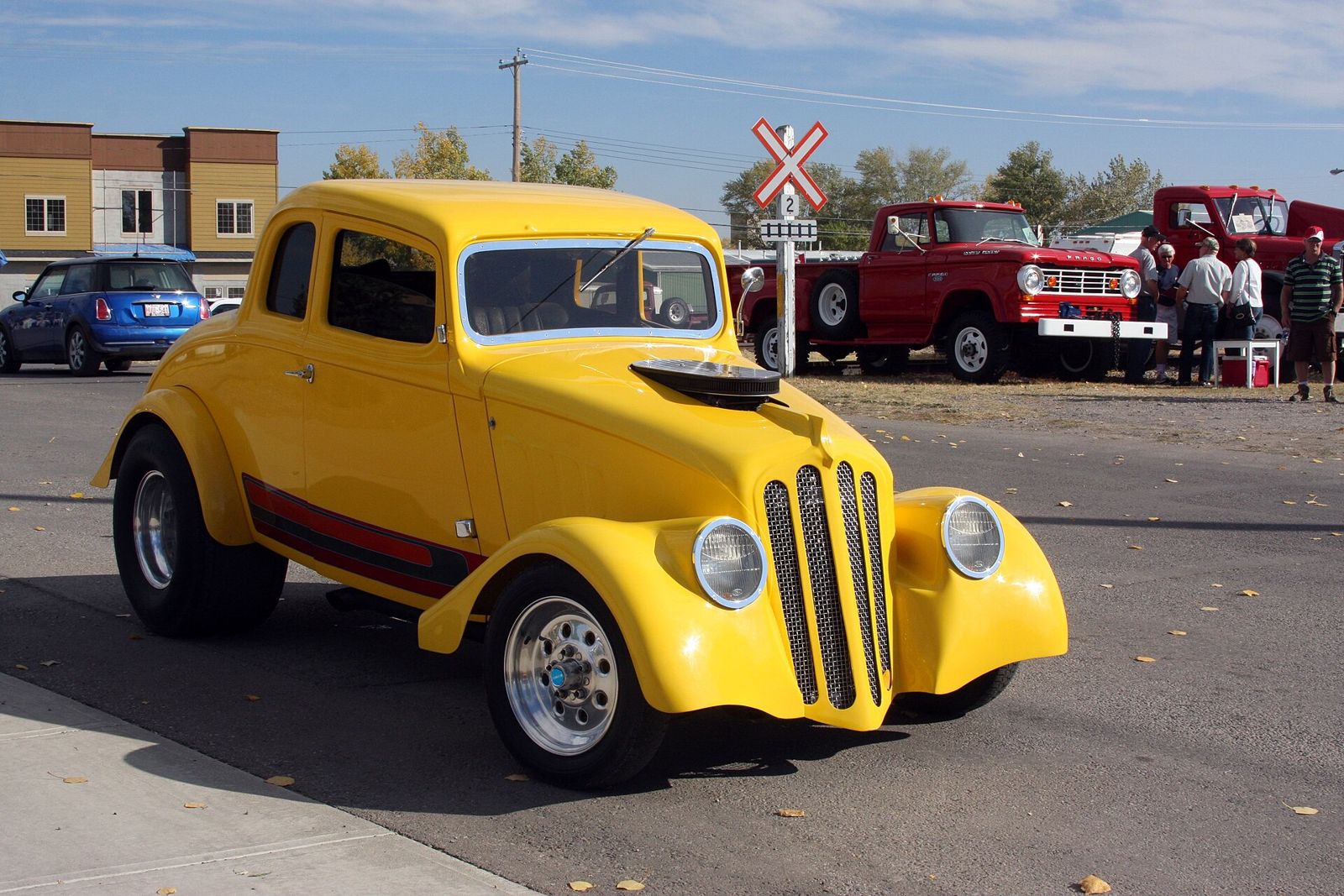
A 1933 Willys built "into a Pro Street dragster with a Chevrolet 355cid V8" (uploader). It shows the tubbed, big-rear-tire stance. Photographed in 2011; build date unknown. Creator: dave_7 from Lethbridge, Canada. Date: 2011-09-25 15:20. Source: Wikimedia Commons. License: CC BY 2.0.

The 1980s look from Sullivan’s Dayton garage, a street car he could drive, which Reyes named Pro Street in 1979
“I don’t ever recall a Pro Stocker having a supercharger on it.”1 That is Scott Sullivan, pushing back on the common description of Pro Street as an NHRA Pro Stocker for the street. He was working from a small shop in Dayton. Steve Reyes put the name on it in 1979, and in 1988 Sullivan drove his ’55 Chevy cross-country.
Sullivan admits the real start is “much harder to pin down”: in 1974 he tucked 15x9 Cragars and 11.5-wide tires under a ’71 Demon by tubbing it.1
Sullivan, a self-taught builder working from a small shop in Dayton, Ohio since 1977, is cited as one of the style’s originators.1 What he was after was “something that looks like a race car, is plenty fast, but is fun to drive,” putting “all the things I saw as a kid at the dragstrip on a street car.”1
Who named it
The name came before anyone agreed on the origin. Sullivan dates the label to 1979, when photographer-writer Steve Reyes wrote an article featuring Sullivan’s ’66 Nova, a ’66 Chevelle called “Goldenrod,” and others, and called the trend “Pro Street.”1◐
The cars were meant to be driven, and he proved it: in 1988 he drove his ’55 Chevy “Cheez Whiz” cross-country with photographer Jeff Smith.1
The look (1979–late 80s)
The recipe: large rear tires under stock-looking bodies via wheel tubs, back-halved or tube chassis, roll cages, and often superchargers.2◐
He does not recall a Pro Stocker with a supercharger on it. Reyes called the trend Pro Street in 1979. In 1988 the ’55 Chevy “Cheez Whiz” still went cross-country.
A decade later the next style got a name the same way, by Pro Street’s example: see Under the Light Pole for Pro-Touring.
Open questions & disputed details
2 items
From the detective’s notebook: where the sources disagree, where we have only one, and what we are still looking for. Each item links back to its place in the story.
Single source so far. Which 1979 magazine ran the Reyes article? Sullivan cites it in Hot Rod, but we have not identified the magazine or issue.1 ↩
Single source so far. Is that the Pro Street recipe? The trait list comes from magazine summaries in Hot Rod; it needs period features to confirm it.2 ↩
Sources & notes
2 notes
-
John McGann, “What is Pro Street? Builder Scott Sullivan Answers the Question,” Hot Rod, Apr 1, 2024. https://www.hotrod.com/features/pro-street-pioneer-scott-sullivan-interview (accessed 2026-10-12) ↩↩↩↩↩↩↩
-
Hot Rod, “What Is the Definition of Pro Street?” https://www.hotrod.com/features/where-it-all-began-what-is-pro-street (accessed 2026-10-12) ↩↩