People & Builders 1930s Los Angeles, California
Roy Hagy: The Man Who Wouldn’t Use Lead
Roy Hagy was a customizer who wouldn't use lead. Almost everything known about him comes from one oral source.
Confidence MediumHow we know this
- Confidence
- Medium
- Source types
- oral (via Ganahl), secondary
- Last verified
- 2026-10-12 (Round 2)
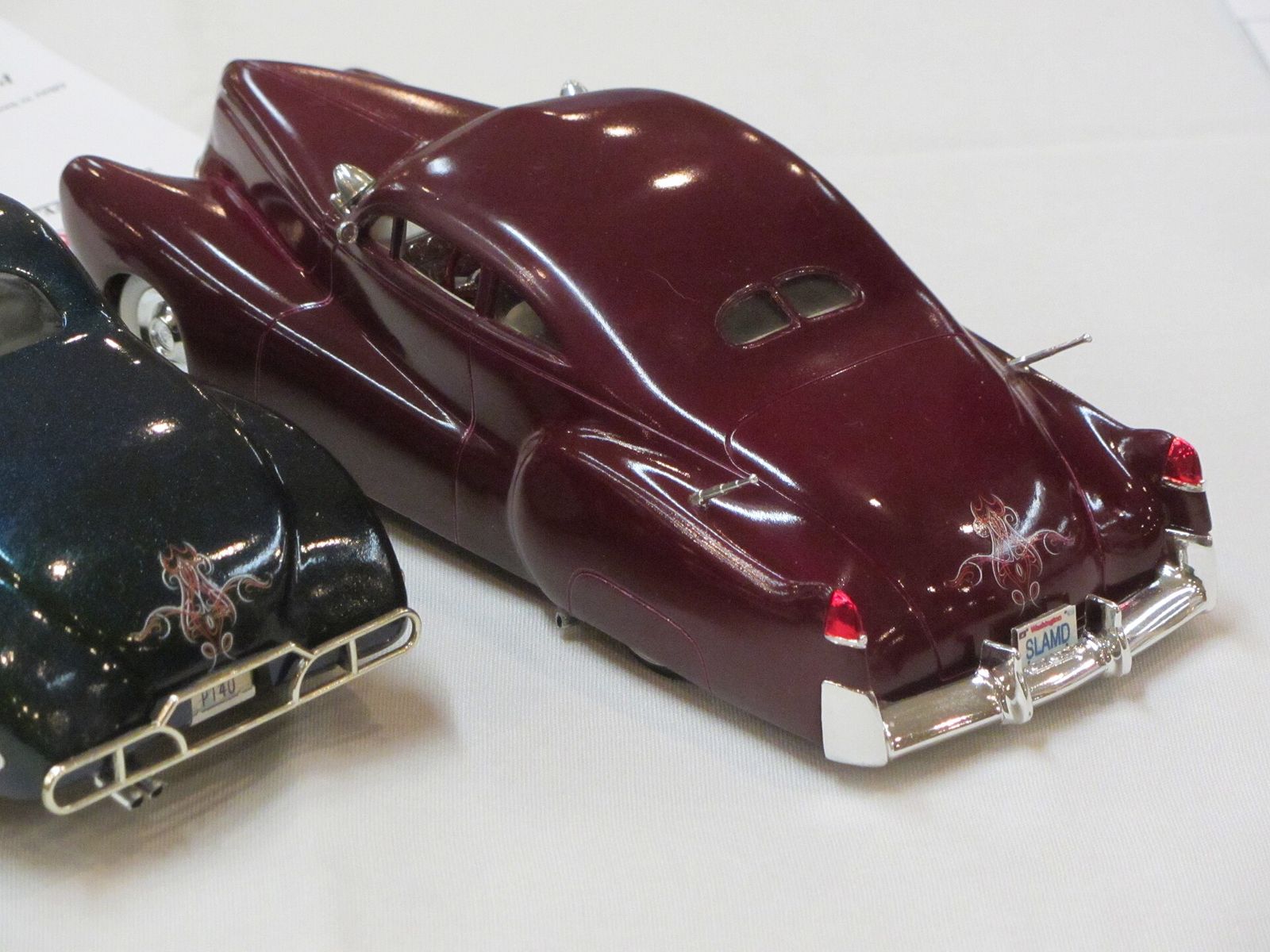
A scale model of a 1940 Mercury custom at a model-club show. It shows the smoothed "fat-fender" '39–'40 style Sparks says Hagy worked on. It is not a Hagy car. Creator: JOHN LLOYD from Concrete, Washington, United States. Date: 2016-02-28 10:32. Source: Wikimedia Commons. License: CC BY 2.0.

He would metal-finish everything, he worked alone, and he wouldn’t use much lead
Roy Hagy wouldn’t use much lead. He would metal-finish everything, and he always worked alone. Almost everything known about him comes from one oral source.
Others learned from him. George and Tom Bistagne learned bodywork from Hagy around 1939–40.1 One known car is Tommy Winship’s 1940 Ford coupe (later Earl Bruce’s), with a chopped top, filled quarter windows, rounded door corners, and dechromed trim.1
Tom Sparks worked for him around 1942–43, at about 15, and remembered the rule of the shop: “Hagy worked mostly on what we call fat-fender cars today: ’36s, ’39-’40s. He did mostly filling, removing handles, recessing license plates, and chopping tops. Hagy didn’t like to use much lead; he’d metal-finish everything. ... And he always worked alone.”1
Sparks was an unpaid “sand boy” and learned gas welding and painting there.1
Where he fits
Hagy and Jimmy Summers are named as two of the first LA shops to specialize in customizing production cars, as opposed to coachbuilders like Bohman & Schwartz or Coachcraft.1 His shop was on Vermont at Second Street. When Sparks worked there, Hagy was working out of a back room at Russell Johnson’s paint shop.1
Sparks also had a view on where chopping came from: “It had to start sometime in the mid- to late-1930s.” He added a caveat: “We weren’t in Hollywood, and we didn’t go very far.”1
Why it matters
That one rule is what sets him apart. Metal-finishing rather than leading puts Hagy against the grain of the “lead sled” era that followed (Techniques).
He didn’t like to use much lead. He would metal-finish everything, and he always worked alone. Almost everything known here comes from Sparks.
Open questions & disputed details
1 item
From the detective’s notebook: where the sources disagree, where we have only one, and what we are still looking for. Each item links back to its place in the story.
Single source so far. How much rests on Tom Sparks? Almost everything here comes from one oral source: Tom Sparks, interviewed by Pat Ganahl for The American Custom Car, as Kustomrama relays it.1 We have not seen the book itself. ↩
Visual references (external)
These are copyrighted or rights-restricted images, so we link to them instead of copying them.