People & Builders 1940s Glendale, California
Barney Navarro: Paying for Parts with Labor
Barney Navarro paid for parts with his labor, machining the castings for the first Weiand intake Phil Weiand ever made. He raced with the Glendale Strokers, a belly tank and his own manifolds.
Confidence MediumHow we know this
- Confidence
- Medium
- Source types
- oral, secondary, primary (patent)
- Last verified
- 2026-10-13 (Round 4)
- Principal source
- Tony Thacker's American Hot Rod Foundation biography, built on Navarro's recollections.2
1919–2007. He paid for the parts with his labor
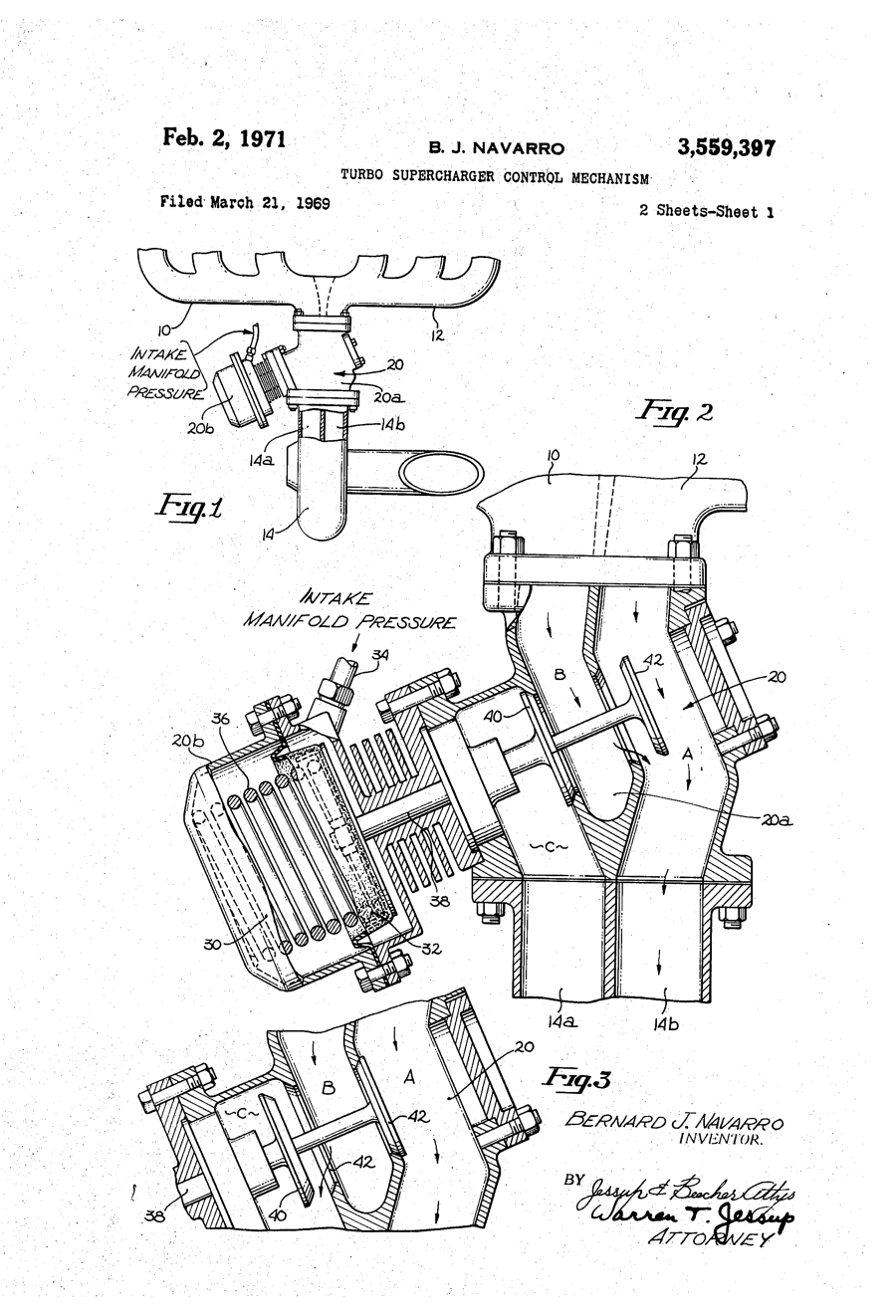
US3559397, “Turbo supercharger control mechanism,” sheet 1. Inventor: Bernard J. Navarro, Glendale, filed 1969-03-21, issued 1971-02-02. Source: Google Patents. License: public domain (U.S. patent drawing). See Patents.
Barney Navarro paid for parts with his labor. His ’39 Tudor ran the first Weiand intake Phil Weiand ever made, and Navarro paid for it by machining Weiand’s first batch of 10 castings.2◐
He had been around machines since boyhood. He got his start at 10, as a gofer during the overhaul of his father’s Willys-Knight. He attended Eagle Rock High and night machine-shop classes at Glendale High, and he once cut a straight-eight Locomobile in half for the Weaver brothers’ midget.2
In 1940 came the Glendale Strokers: Navarro with Tom Beatty, George Hill and Doane Spencer.2⚠ At the last prewar Muroc meet, in November 1941, he ran 107 mph.2
After the war came the business, built on credit. In 1947 he went into business, with patterns by Hermann Husbey and castings on credit from Victor Caliva’s Aircraft Foundry (“pay for them as he sold them”).2
His own engine was the advertisement. His blown flathead was advertised in the first issue of HOT ROD (1948). It was a de-stroked 176 ci ’41 block with Winfield cam, Kurten ignition and a 3-71 GMC blower driven by four V-belts, with four Strombergs mounted back-to-back. It ran 139.75 mph at El Mirage, Sept 25–26, 1948.2
The old club friendship produced a record car. With Tom Beatty, he built a 4-71-blown 295 ci Merc belly tank that set a Class D Lakester record of 185.80 mph at the 1951 Bonneville Nationals⚠, and 197.17 mph two-way in 1952.2 Whether that record was 185.80 is still open.
The machine shop outgrew racing. Navarro Engineering started at 718 Verdugo Road, then moved to 5142 San Fernando Road, Glendale. The shop built a Hemi boat for Henry Kaiser, a heart-lung machine used for 13 years at Kaiser Hospital in Hollywood, and concrete-cutting tools.2
He died August 20, 2007, his 88th birthday. His patterns went to Mike Herman of H&H Flatheads. His favorite saying: “There’s nothing more fun than learning.”2 The first intake had been paid for by the machining. The parts were paid for with his labor.
See also: Deer Park and Spokane’s nitrous secret, where Hot Rod’s account of the first nitrous racers recalls Navarro injecting straight oxygen into his track car’s engine and giving it up after a meltdown.
Open questions & disputed details
3 items
From the detective’s notebook: where the sources disagree, where we have only one, and what we are still looking for. Each item links back to its place in the story.
Single source so far. The first Weiand intake? That Navarro’s ’39 Tudor ran the first intake Phil Weiand made, paid for by machining Weiand’s first ten castings, comes only from the AHRF profile.2 ↩
Disputed. Strokers or Stokers? AHRF writes “Glendale Strokers”;2 Kustomrama spells it “Stokers” (see Tom Beatty). ↩
Disputed. 185.80 or 188.284 mph? AHRF gives the 1951 Class D Lakester record as 185.80 mph;2 the auction listings for the car give “188.284 MPH At Bonneville In 1951, A Record The First Time Out.”1 The SCTA’s 1951 record list would settle it. ↩
Sources & notes
2 notes
-
“1951 Tom Beatty Belly-Tank Lakester,” Gooding & Company, Pebble Beach auction, 2007 (lot page). https://www.goodingco.com/lot/1951-tom-beatty-belly-tank-lakester (accessed 2026-10-22) ↩
-
Tony Thacker, “Barney Navarro,” American Hot Rod Foundation. https://ahrf.com/pioneer/barney-navarro/ (accessed 2026-10-12) ↩↩↩↩↩↩↩↩↩↩↩↩