Companies & Shops 1960s California, Ohio
Mickey Thompson: The Pressman Who Dug the Post Holes Himself
Mickey Thompson dug the post holes for his own drag strip after his shift at the Los Angeles Times. The pressman with a garage and no money went on to the slingshot, the slick and a mail-order wheel.
Confidence MediumHow we know this
- Confidence
- Medium
- Source types
- Hot Rod profile (Dec 1978; Thompson in his own words), NHRA National Dragster editor's photo feature (2013, quoting a 2013-era biography), SEMA Hall of Fame (1984), Wikipedia (secondary), a RACER company history that names Thompson's wheels
- Last verified
- 2026-10-16 (Round 15)
- Open issues
- ⚠ who deserves credit for the slingshot dragster and when it debuted; ⚠ the Brighton 1963 story; ◐ nearly every "first" below is Thompson's own claim; the Mickey Thompson tire and wheel brand's later ownership was not traced; no Alhambra or El Monte local-paper coverage found yet
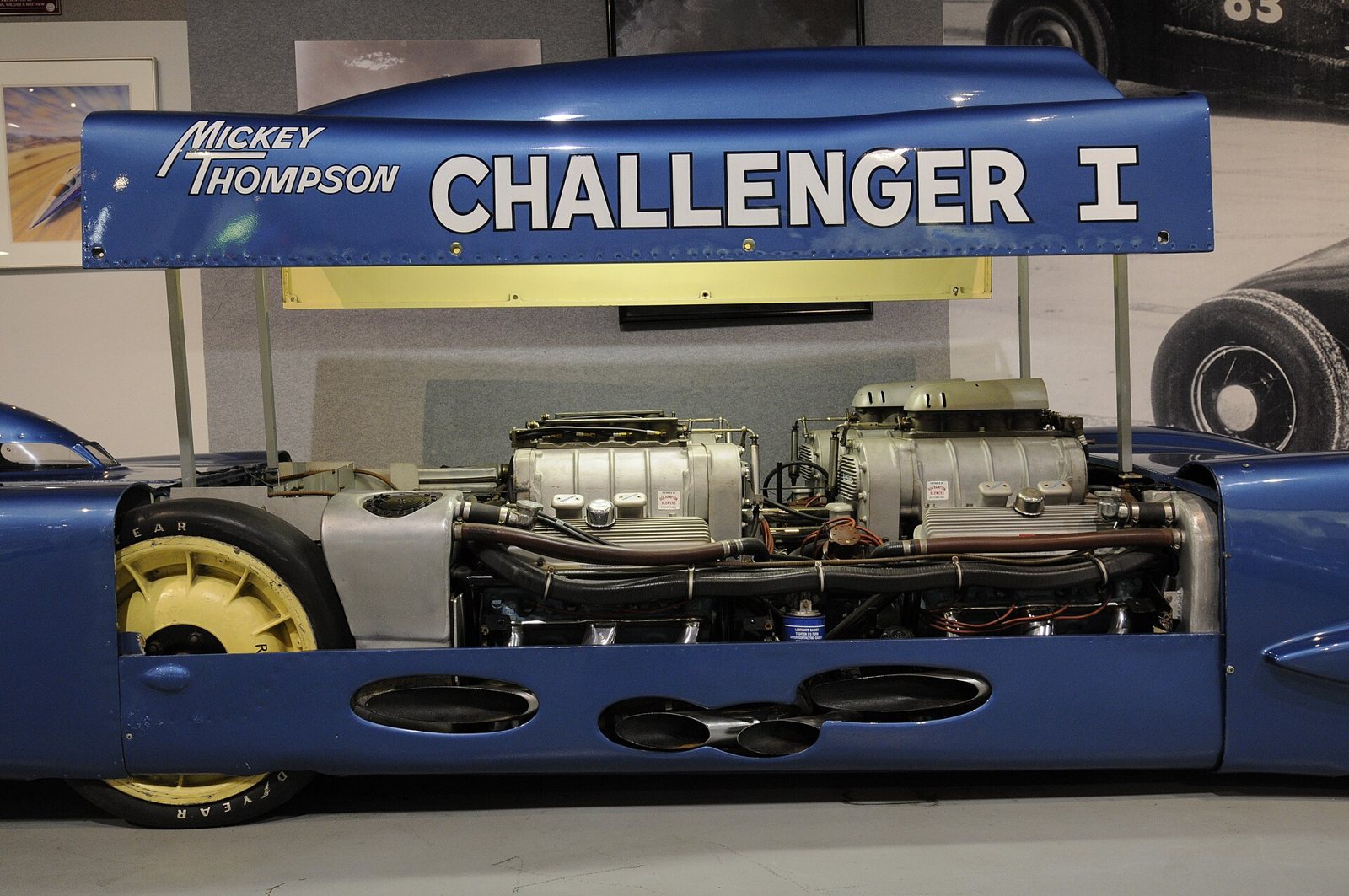
Challenger I, Thompson's 1960 Bonneville record car, at the Wally Parks NHRA Motorsports Museum (2008). Creator: Wally Parks NHRA Motorsports Museum. Date: 2008-07-07. Source: Wikimedia Commons. License: CC BY-SA 2.0.

He dug the post holes himself after the shift at the Los Angeles Times, then the slingshot, the slick and a mail-order wheel
In their own words
“I didn’t have the money to buy what few hop-up pieces there were then, so I had to build my own boxed rods, grind my own cam, and fabricate my own quick-change rearend ... When you don’t have any money, you learn to do it yourself.”
— Mickey Thompson, in Hot Rod (Dec 1978), on growing up in El Monte, California.1
“I dug the post holes by hand, scrounged up the pipe I used for the fence posts, nailed together the timing tower, and sold pit passes,” Mickey Thompson told Hot Rod in 1978, remembering the drag strip he built after his shift at the Los Angeles Times. “I was really excited when 10,000 people showed up for opening day.”1
He was a pressman with a garage and no money.
Wikipedia says Marion Lee Thompson was born December 7, 1928, in Alhambra, California, where his father, Captain Marion L. Thompson, was a police officer. Thompson himself told Hot Rod he was “growing up in El Monte,” where “my dad was a cop, and you know what cops thought about hot rods 35 years ago.”51 In his early 20s he worked as a Los Angeles Times pressman while pursuing hot rodding, per Wikipedia and his own 1978 account: “I was a pressman at the Los Angeles Times, had my own garage, and constructed a drag strip in my spare time.”51
Without parts he could afford, he built everything: a hot A-bone roadster, a twin-flathead ’32 Bantam coupe, and then, for Bonneville, a coupe with a $40 Chrysler Hemi and a $10 4-71 blower. “I was probably the first guy around that put together a blown Chrysler hemi,” he said.1◐
Thompson is “widely credited,” NHRA’s National Dragster editor wrote in 2013, with the slingshot dragster design on his 1954 car, “although there’s some fuzziness on the issue.” NHRA quotes Thompson’s explanation of the layout and then adds that “a Santa Ana hot rodder, LeRoy Neumayer, said it reminded him of a slingshot, and the name not only stuck, but the design was quickly adapted by everyone else.”2 That Santa Ana tie is the one that pulls Thompson into the archive’s Santa Ana Drags story, the strip where Hart ran the show until 1959 and later, in 1965, succeeded Thompson at Lions. Great Bend and the SRCA hosted the 1955 Nationals where Wikipedia says the Panorama City Special debuted.⚠
Then there was Lions. Thompson says he “built and ran Lions Drag Strip for eight years.”1 Wikipedia calls him the strip’s first manager, in 1955.5 The same strip is where, Hot Rod writes, Don Garlits “lost a portion of his foot from an exploding 2-speed transmission,” which “ended the popularity of Thompson’s famed slingshots.”1 Explosions of drivetrain parts are the hazard that Lakewood’s steel bellhousing was marketed against, though SEMA describes flywheel-and-clutch failures, not a transmission case.
In July 1961, NHRA says, Thompson “trailered these four Pontiac-powered cars” to Southern California’s March Air Force Base and broke eight FIA international records and six of 10 American national records. At the 1962 Nationals, NHRA says, Jack Chrisman drove his 432-cubic-inch aluminum Pontiac-powered Dragmaster to an 8.76, 171.75-mph win over Don Garlits in the Top Eliminator final.2 In 1978 Thompson called his biggest drag racing thrill “entering 10 Pontiac-powered cars back in ’62 and winning all 10 classes they competed in.”1◐
In 1961, on the Houston Freeway Dragstrip page, strip owner Carl Gay booked Hayden Proffitt and his “Mickey Thompson–owned, 421-powered aluminum Pontiac Catalina” at the Houston strip, and within a year the Gay brothers were racing Catalinas of their own. That page’s source is an NHRA.com feature on the Gay brothers, not the 1978 profile.
In 1963, per SEMA and Wikipedia, he launched Mickey Thompson Performance Tires. SEMA lists among his innovations “S/S Cheater Slicks and raised white letter tires,” and he told Hot Rod he “built some of the first, if not the first set of drag slicks out of recapped ’47 Indy tires” and “used the first super-wide, low-profile tires.”351◐ The tires were part of a bigger business. Wikipedia adds that he “went into the performance aftermarket business in the early 1960s.” Don Prudhomme, quoted by NHRA from a biography, said Thompson “was the first guy I ever heard who would take his cars to the dragstrip during the week to test. None of us could afford to test, so when Mickey showed up on the weekend, his cars were ready to kick ass.”2
Elsewhere, a Brighton, England, speed-trial story is told twice: Wikipedia has Thompson and Dante Duce demonstrating Thompson’s Harvey Aluminum Special dragster there in 1963, while THE SHOP has Dean Moon sending his own dragster and a sports car with Duce.⚠ Moon Equipment has the Brighton mix-up and the California shops of the era.
His name reached Ohio. RACER’s company history says that, three years after Summit Racing opened its first Akron store in 1969, Summit tested mail order “by placing small ads for Mickey Thompson ET wheels in Hot Rod and Car Craft magazines.”4 Summit Racing’s first mail-order ads were for his wheels. Lakewood Industries, the bellhousing maker, was another response to drivetrain explosions at the strips. Moroso is another racer-turned-parts-maker who ended up owning a track.
After the Indianapolis years and the Ford-backed Mustang Funny Cars of the late 1960s, Thompson founded the off-road sanctioning body SCORE; “Hell, the best part of the show was out there in the desert,” he said.1 SEMA says he later formed SCORE International and the Mickey Thompson Entertainment Group.3
Hot Rod opens its 1978 profile by calling Thompson and Ed Iskenderian “close personal friends” who “happen to be the ultimate parts magnates.”1 Ed Iskenderian is the friend Hot Rod paired with Thompson as a parts magnate.
Thompson and his wife Trudy were murdered at their Bradbury, California, home on March 16, 1988, in a case SEMA says went unsolved until 2007.35
He dug the post holes by hand after his shift at the Los Angeles Times. He was a pressman with a garage and no money.
See also: The Web of Influence; Golden State Raceway, Santa Maria, where a Mickey Thompson fuel dragster held the 1969 AA-Fuel record.
Open questions & disputed details
5 items
From the detective’s notebook: where the sources disagree, where we have only one, and what we are still looking for. Each item links back to its place in the story.
Single source so far. The first blown Chrysler Hemi? Only Thompson says so (“probably the first guy around”), in 1978; it is a boast, not a documented first.1 ↩
Disputed. Where did the first slingshot run? Thompson’s 1978 account says he “built the first slingshot-style dragster” and that the ’54 car “turned over 150 with Brown’s Chrysler at San Fernando.” Wikipedia says the Panorama City Special debuted at Great Bend in 1955, citing a Thom Taylor Hot Rod piece we did not see.15 We found no Great Bend entry list naming the car; see Great Bend and the SRCA. ↩
Single source so far. The first drag slicks? The slicks from recapped Indy tires and the first wide, low-profile tires are Thompson’s own claims, repeated by SEMA and Wikipedia.351 ↩
Single source so far. Ten Pontiacs, ten class wins in 1962? That is Thompson’s 1978 recollection; we have no 1962 class list.1 ↩
Disputed. Whose dragster ran at Brighton in 1963? Wikipedia has Thompson’s Harvey Aluminum Special demonstrated there with Dante Duce;5 THE SHOP has Dean Moon sending his own dragster with Duce. See Moon Equipment; the sources do not reconcile. ↩
Sources & notes
5 notes
-
Gray Baskerville, “Mickey Thompson: The Speed King’s Unstoppable Legacy,” Hot Rod, Dec 1978 (online Feb 2, 2024). https://www.hotrod.com/features/speed-king-mickey-thompson-december-1978-982-1390-78-1 (accessed 2026-10-16) ↩↩↩↩↩↩↩↩↩↩↩↩↩↩↩
-
Phil Burgess, “The Thompson Files,” NHRA, Mar 1, 2013 (quoting Erik Arneson’s Mickey Thompson: The Fast Life and Tragic Death of a Racing Legend). https://www.nhra.com/news/2013/thompson-files (accessed 2026-10-16) ↩↩↩
-
“HOF - Mickey Thompson,” SEMA Hall of Fame, 1984. https://www.sema.org/hof/1984/mickey-thompson (accessed 2026-10-16) ↩↩↩↩
-
“IHRA: Summit Racing Equipment the definition of invested series partner,” RACER, Aug 9, 2016. https://racer.com/2016/08/09/ihra-summit-racing-equipment-the-definition-of-invested-series-partner (accessed 2026-10-16) ↩
-
Wikipedia, “Mickey Thompson” (secondary). https://en.wikipedia.org/wiki/Mickey_Thompson (accessed 2026-10-16) ↩↩↩↩↩↩↩↩