People & Builders 1940s California, Montana
Jimmy Summers: The Customizer Across from Fairfax High
Jimmy Summers and his brother Bill started as street-corner fender men with tools in a bag, then opened a shop at 7919 Melrose Avenue, across from Fairfax High.
Confidence LowHow we know this
- Confidence
- Low
- Source types
- secondary
- Last verified
- 2026-10-12 (Round 1)
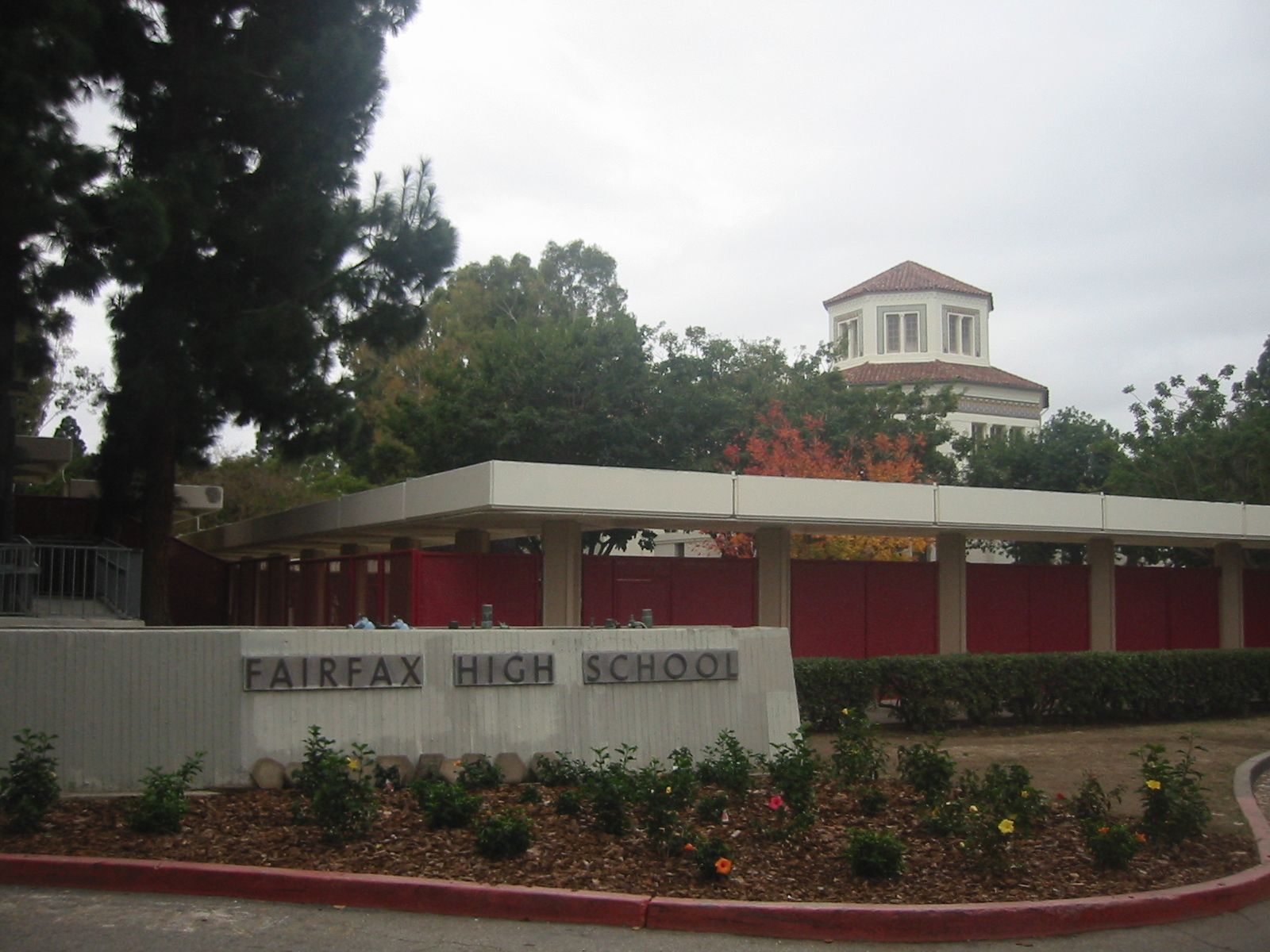
Fairfax High School, Los Angeles, in 2006. Summers' Melrose Avenue shop stood across from it. Creator: Gary Minnaert (Minnaert). Date: 2006-12-16. Source: Wikimedia Commons. License: Public domain.

Street-corner fender men with tools in a bag, then a custom shop on Melrose across from Fairfax High
His son Lee remembered how it began: Jimmy and his brother Bill worked as street-corner fender men. “They had tools in a bag, and they would go from block to block looking for cars that needed a fender repair.”1 By the late 1930s the shop was at 7919 Melrose Ave., across from Fairfax High School.
James Merlin Traft Summers was born September 22, 1913, in Lewistown, Montana, and died October 24, 1968.1 Most of what we know comes from Sondre Kvipt’s interviews with his children (Lee, Kris, Karen) and family albums, published in The Rodder’s Journal #83 (2020) and on Kustomrama.1 Nearly everything below comes from that one family-sourced research project.◐
By the late 1930s, his shop was at 7919 Melrose Ave., across from Fairfax High School.1 Somewhere in the family albums sits his 1938 Muroc timing tag: 94.73 mph with a stock V8.1 Alex Xydias, a Fairfax student, recalled “just four plastered walls, a bare concrete floor, and a gas jet” lit on cold mornings,1 and in a later interview said he watched the shop guys for hours “until they’d kick me out.”2 Tom Sparks (who worked for Roy Hagy c.1942–43) told Pat Ganahl that Summers “was like a god to us.”1
His customers knew what they wanted. Xydias described the customer mindset: they “did not want Summers to provide them with a hot Ford as much as they wanted him to provide them with a fake Cord.”1
Motor Life (May 1955) credited Summers with the first channeling job.1◐ Shop employee Bob “Barbells” Fairman built a chopped ’36 Ford with full fadeaway fenders, the first Xydias had seen.1
After the war he added a product line. From 1946–47 Summers sold stamped “Summers Fender Extensions” for 1942–48 Chevrolets, Pontiacs and junior Buicks; a 1948 Hot Rod ad lists $69.50 per primered set.1 Popular Mechanics (May 1947) reported about one hand-tailored car per week.1
In 1962 he built the body for Tony Nancy’s dragster.1
They had tools in a bag and went from block to block. The shop was at 7919 Melrose, across from Fairfax High.
Open questions & disputed details
2 items
From the detective’s notebook: where the sources disagree, where we have only one, and what we are still looking for. Each item links back to its place in the story.
Single source so far. How much rests on the family? Nearly everything on this page comes from Sondre Kvipt’s interviews with Summers’s children and the family albums, published in The Rodder’s Journal #83 and on Kustomrama.1 ↩
Single source so far. The first channel job? Only Motor Life (May 1955), as Kustomrama reports it, credits Summers with it.1 We have not seen the magazine or a rival claim. ↩
Visual references (external)
These are copyrighted or rights-restricted images, so we link to them instead of copying them.
Sources & notes
2 notes
-
Kustomrama, “Jimmy Summers,” drawing on Sondre Kvipt’s family interviews and cited period magazines. https://kustomrama.com/wiki/Jimmy_Summers (accessed 2026-10-12) ↩↩↩↩↩↩↩↩↩↩↩↩↩↩↩
-
StreetMuscle, “The Garage With Dennis Episode 14, So-Cal Speed Shop.” https://www.streetmusclemag.com/news/video-the-garage-with-dennis-episode-14-so-cal-speed-shop/ (accessed 2026-10-12) ↩