Drag Racing & Strips 1950s Texas Grassroots
Houston Freeway Dragstrip
Houston Freeway Dragstrip, near Dickinson, Texas: the 1958 showdown, the Gay family years and the touring racers who stayed at their house.
Confidence MediumHow we know this
- Confidence
- Medium
- Source types
- Grassroots local history site (quotes Chronicle / Garlits), NHRA columns (2008 ghost tracks; 2015 Gay family profile; 2001 Top 50 Snow bio), forum recollections
- Last verified
- 2026-10-15 (Round 10)
- Open issues
- exact closing date (1987 vs "unknown"); exact year the Gay family bought the strip (by 1961 at the latest); ⚠ buyer was Carl and Marie Gay, not Don, per NHRA (Round 10 correction)
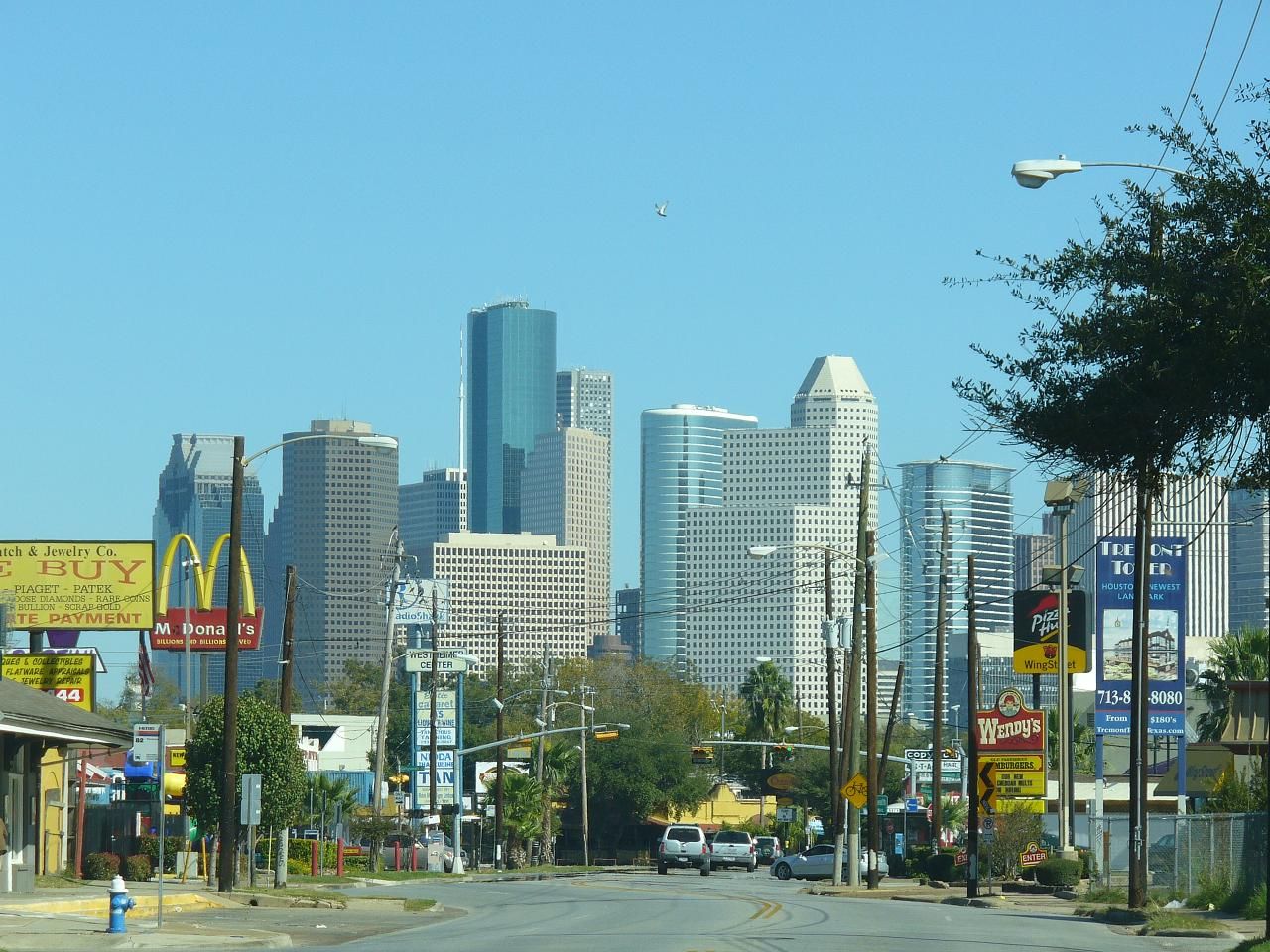
Houston from Westheimer. The Freeway Dragstrip sat south of the city on I-45 near Dickinson, not on this street (see Westheimer cruising). Creator: iodine127. Source: Wikimedia Commons. License: Public domain.

Touring racers stayed at the Gay family’s house, and we credit Carl and Marie Gay as the buyers
In their own words
“A group of the West Coast fuel drag racers are doubting the times you’ve been setting there in the East, so everybody is figuring that it’s time for a real showdown...”
— Invitation letter to Don Garlits from a Freeway Drag Strip promoter, July (year in Garlits’s memoir context ~1958), quoted via houstonfreewaydragstrip.com. Voices
“They’d all stay at our house,” Don Gay recalled of the touring racers who came through his family’s track. “We’d say, ‘Hey, my mom has a two-story house. Why don’t you stay?’ We’d sit by the swimming pool on Friday night and drink and talk.”3 The strip was the family’s. A local page says Don bought it in 1960, when he was about 13. We therefore credit the Gay family (Carl and Marie) as buyers.
The strip sat south of Houston on the east side of I-45 / Gulf Freeway near Dickinson, Texas (today roughly I-45 and 16th St / FM 646). It was one of the Gulf Coast’s purpose-built quarter-miles. Local history pages call it, over time, Freeway Drag Strip, Houston International Speedway / Raceway / Dragway, South Texas Dragway, and related tower names. It ran as an NHRA Division 4 track and closed in the late 1980s; a Walmart later occupied the old starting-line area.12
Before the strip, Houston was already racing on the street. There was Road Kings activity, unfinished pavement in the Westbury subdivision, and Richmond & Post Oak. The Greater Houston Timing Association was part of that street racing, and there were events at the Hitchcock blimp base and at Ellington Field. The local site: 20,000+ at an Ellington event.◐ That club chronology comes from the history site.
Land for the strip was donated by the Fingers Furniture family, per the same local history site.◐1
The strip opened in fall 1957, described as the region’s first known purpose-built drag strip, as opposed to airports.1
The Houston Chronicle Magazine of March 1, 1959 (“The Flag Says Go”) named starter Tim Evers, with Bobby Langley’s Scorpion II and Lin Huiet among those “zooming over 160 mph.”◐ We have that magazine only as the history site quotes it.
The strip drew outside racers early. Don Garlits’s memoir, quoted on the history site, recounts a July invitation to a California, Florida and Texas fuel showdown at Freeway. Pete Ogden was in a Palamides streamliner. Jack Ewell was in Kamboor’s Jado Special. Red Case was there, and Texas star Bobby Langley in Scorpion II. It was Garlits against the field.1
Who bought it
Our local source says Don Gay bought the track in 1960 and added lights, a Christmas tree, timing, stands and a PA.1◐ It later became Houston Int’l Speedway, then Houston Int’l Raceway.3 Don, who died June 30, 2007, at 60, was only about 13 in 1960. We therefore credit the Gay family (Carl and Marie) as buyers. The improvements may well be theirs too. The purchase came no later than 1961, when Carl booked Hayden Proffitt there (below). The exact year is still open.
The Gay family years
The Gays brought in the factory cars. In 1961 Carl Gay booked Hayden Proffitt and his Mickey Thompson–owned, 421-powered aluminum Pontiac Catalina factory experimental. Don was 14, legal driving age in Texas then. “Within a year” he had an A/Stock Catalina and an A/Modified Production Catalina wagon, and younger brother Roy ran a B/Stock GTO.3
In 1964, Don, still a Dickinson High student, won A/Stock class at the Indy Nationals. That year Carl booked Arnie Beswick’s blown GTO, and the family decided to build their own.3
The result was Infinity. With lead mechanic James Osteen they took a ’65 GTO off the lot, moved the front wheels forward four to five inches, and added a fiberglass front end, hood and doors. The name came from the opening of TV’s Ben Casey. It debuted July 3, 1965, at the family track and lost to “Dyno Don” Nicholson that day when the transmission broke.3 Infinity II (1966) had a Jay Howell tube chassis. The series ended with Infinity V, a 1970 Firebird.3
The family’s two-story house was where touring racers stayed (see Don’s quote above and Voices).
The track also saw a milestone. Fort Worth’s Gene Snow made what NHRA calls Funny Car’s first 200-mph pass, 200.88 mph, “at Don and Carl Gay’s track in Dickinson, Texas.”⚠ When that pass was is still open.
Roy Gay was runner-up to Eddie Schartman at the 1967 Manufacturers Championships at OCIR. He was killed in a 1972 motorcycle accident.3
The family went on to a new track. In the late 1980s the Gay family and the Angel brothers (Greg, Gary and Glenn) founded Houston Raceway Park in Baytown, on an old rice farm.3 On Oct. 6, 1988, Gene Snow ran the first sub-five-second pass at an NHRA event there (see Gene Snow). This supports the Yellow Bullet memory below that the Dickinson track closed about 1987.
Tower and sanctioning names shifted (NHRA / AHRA labels appear on different-era photos). Treat the name list as a photo-caption census, not a legal chain of title.1
The records are disputed too. Local historians and Standard 1320 researchers argue that Kent Chatagnier of Beaumont (“Kent’s Speed Shop” fueler) ran 197–201+ mph at Houston in 1960 under then Drag News rules, later “forgotten” when record-keeping was reset.◐ NHRA does not recognize it.
NHRA.com’s “Ghost tracks” (2008) says that by 2000 the site was largely demolished, and a reader noted that a Walmart sat on the old starting line.2
As for the closing, a Yellow Bullet forum recollection says it came at the end of 1987, with Houston Raceway Park (Baytown) opening 1988. Other secondary text says “unknown date.”⚠ When the strip closed is still open.
The racers had stayed at the two-story house. Don was about 13 in 1960. We therefore credit the Gay family (Carl and Marie) as buyers.
See also: Gene Snow, Voices: Strip Owners & Door-Slammers, Texas: Caddo Mills..., Westheimer cruising, Detroit & Cordova (other early purpose-built strips), Regional Scenes.
Open questions & disputed details
7 items
From the detective’s notebook: where the sources disagree, where we have only one, and what we are still looking for. Each item links back to its place in the story.
Single source so far. Is the club chronology reliable? It is enthusiast-compiled on the track’s history site.1 ↩
Single source so far. Who gave the land? That the Fingers Furniture family donated the land comes only from the local history site.1 Lead: Harris County deed records for 1957. ↩
Single source so far. What did the 1959 Chronicle Magazine say? We know it only as quoted on the history site; we have not read the PDF.1 ↩
Disputed. Don Gay or his parents? Our local source says Don Gay bought the track in 1960; NHRA’s Phil Burgess says his parents, Carl and Marie Gay of Gay Pontiac, bought it and renamed it Houston Drag Raceway.14 ↩
Disputed. When was the 200-mph pass? It is dated variously to Aug. 17, 1968, or 1969.4 The three dates and their sources are on Gene Snow. ↩
Single source so far. Did Chatagnier run 200 in 1960? Local historians and Standard 1320 researchers argue so, under the Drag News rules of the day;1 NHRA does not recognize it, so we flag it and do not assert it. ↩
Disputed. When did the strip close? A Yellow Bullet forum recollection says the end of 1987; other secondary text says “unknown date.”51 We use 1987 as a working date until a Chronicle closing notice turns up. ↩
Images
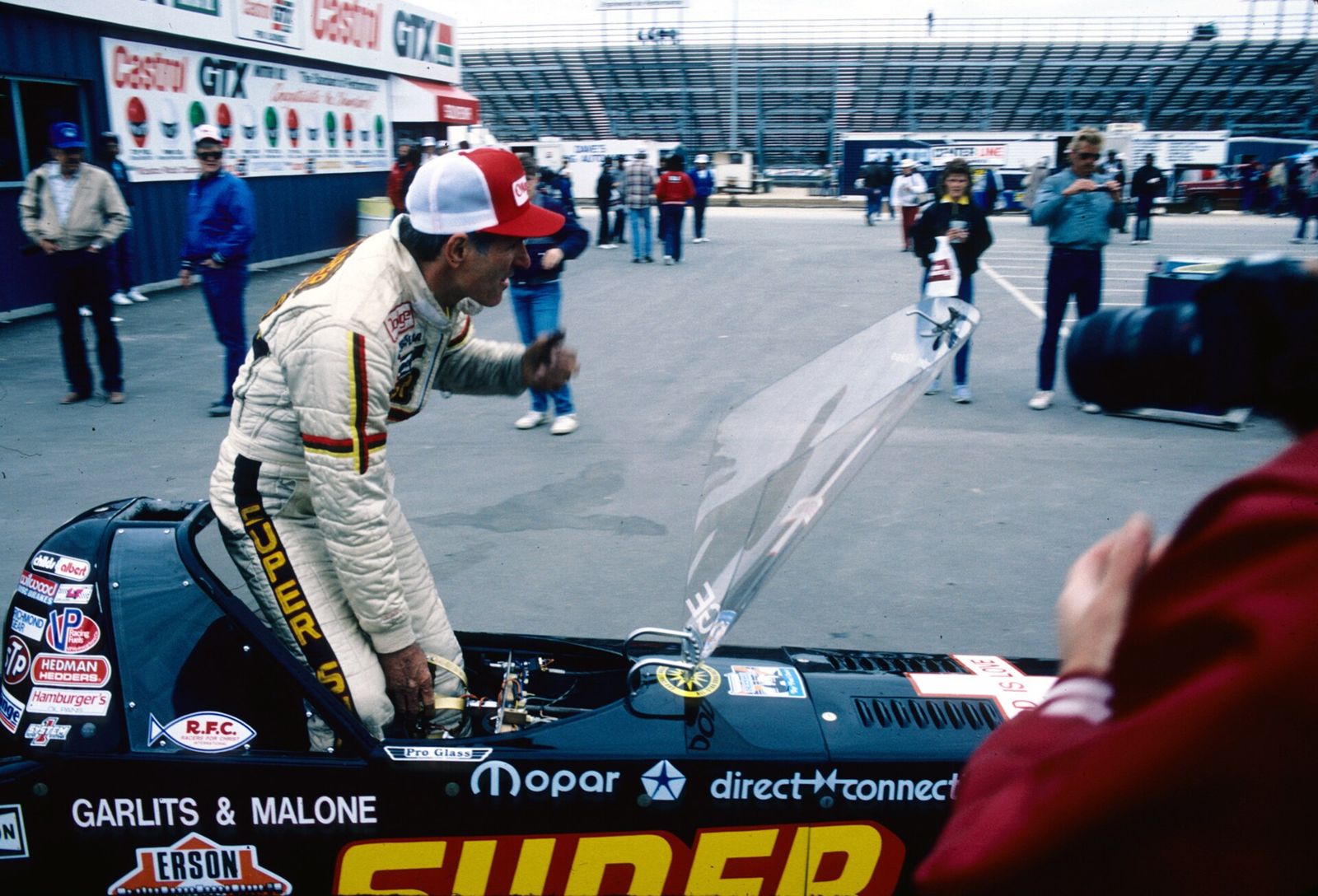
Don Garlits, Texas Motorplex, April 1987. His memoir (quoted on the Freeway history site) describes the late-1950s California/Florida challenge at the strip. Creator: twm1340. Source: Wikimedia Commons. License: CC BY-SA 2.0.

Visual references (external)
- houstonfreewaydragstrip.com photo archive
- NHRA, “Ghost tracks, the scary sequel”
- Dragzine Flashback Friday: Houston International Raceway
Sources & notes
5 notes
-
houstonfreewaydragstrip.com (home + history pages), compiled by Sean S. and contributors; quotes Houston Chronicle Magazine Mar 1, 1959 and Don Garlits memoir text. https://www.houstonfreewaydragstrip.com/ and https://www.houstonfreewaydragstrip.com/houston-international-speedway-history.htm (accessed 2026-10-14) ↩↩↩↩↩↩↩↩↩↩↩↩
-
Phil Burgess, “Ghost tracks, the scary sequel,” NHRA.com, 2008. https://www.nhra.com/news/2008/ghost-tracks-scary-sequel (accessed 2026-10-14) ↩↩
-
Phil Burgess, “Drag racing’s teen terrors,” NHRA.com, Aug 14, 2015. Accessed 2026-10-15. https://www.nhra.com/news/2015/drag-racing-s-teen-terrors ↩↩↩↩↩↩↩↩
-
John Jodauga, “No. 26: Gene Snow,” NHRA Top 50 (2001), and Phil Burgess, “1970: A ‘Super’ season for Funny Car,” NHRA.com, 2016. See Gene Snow for the date conflict. https://www.nhra.net/50th/top50/G_Snow26.html (accessed 2026-10-15) ↩↩
-
Yellow Bullet Forums thread “Houston Raceway park no more” (user recollection of Freeway/HI closing end of 1987). https://www.yellowbullet.com/threads/houston-raceway-park-no-more.2663559/ (accessed 2026-10-14) ↩