Media & Shows 1950s Illinois, Ohio
Customs on Paper and in Plastic
Petersen's 1951 Custom Cars Trend Book drew a line between a restyled car and a custom. AMT's 3-in-1 kits followed in 1958, and Roth's Outlaw was a Revell kit in 1962.
Confidence MediumHow we know this
- Confidence
- Medium
- Source types
- reference (Kustomrama), hobby-press history, company history, secondary
- Last verified
- 2026-10-13 (Round 6)
- Open issues
- Roth royalty figure is "debated"
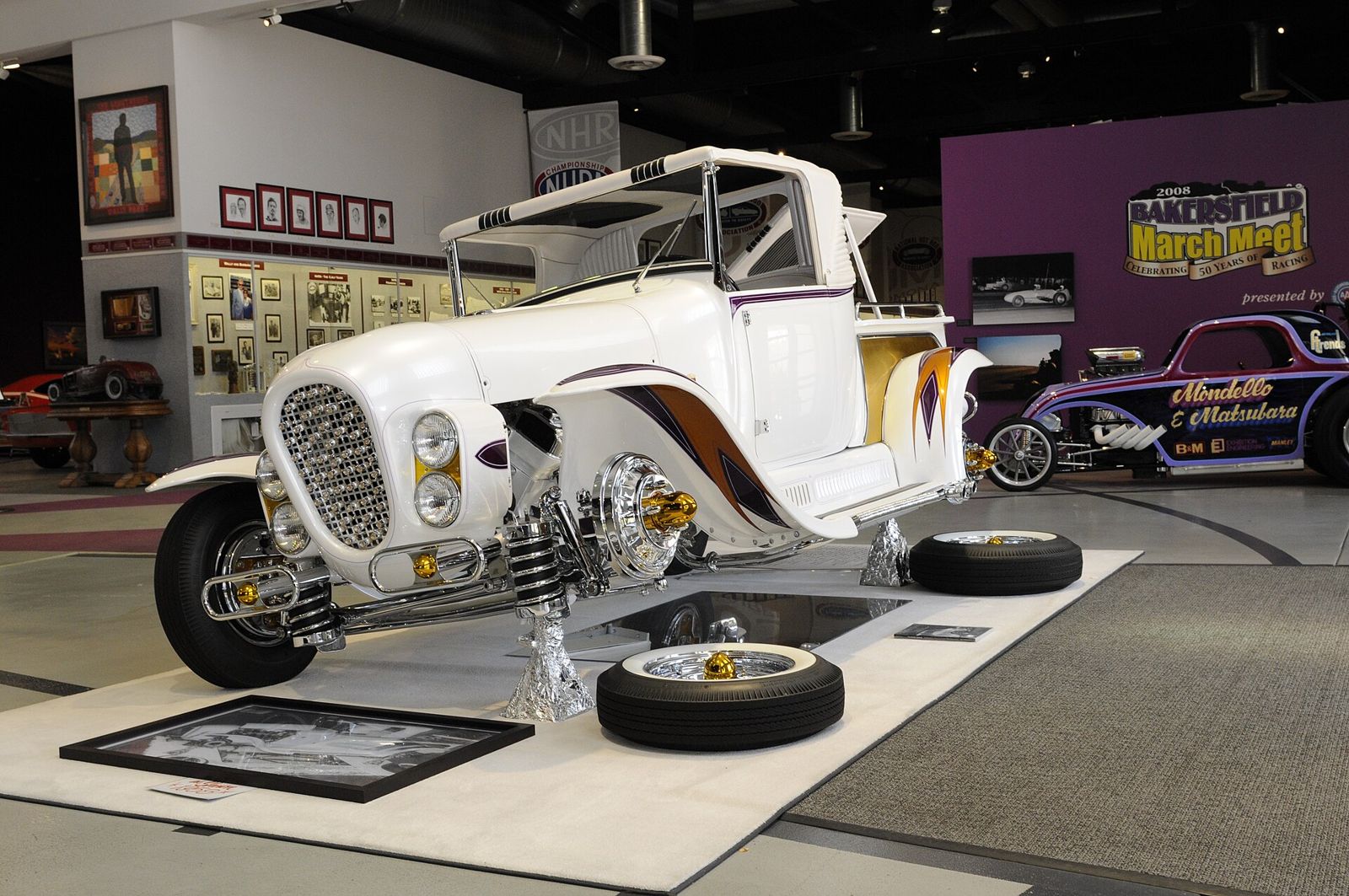
The restored Ala Kart, the Barris-built '29 Ford roadster pickup that won AMBR in 1958 and 1959 and that AMT kitted. Photographed at the Wally Parks NHRA Motorsports Museum. Creator: Wally Parks NHRA Motorsports Museum. Date: 2008-07-07. Source: Wikimedia Commons. License: CC BY-SA 2.0.

The custom went from a 1951 Trend Book to AMT’s 3-in-1 kits in 1958, and then to Roth and Revell
In their own words
“Nothing is original. Everything is in the subconscious, we just ‘tap’ it sometimes and think we have originated something.”
— Von Dutch, hand-lettered sign (via LA Times, 2002). Full context in Voices
The 1951 Trend Book
Petersen’s Custom Cars Trend Book No. 101 (1951) put the custom on paper, and the cars in it were already national. It was published by Robert R. Lindsay and R.E. Petersen and edited by Walter A. Woron. It drew a line between “restyled” and “custom” cars: “A restyled car can include any or all of the following modifications without actually being a custom job: a bull-nose, a deck job, fadeaways, a new grille, and/or new bumpers. When it gets to chopped tops and channeling, the car would more properly be termed a custom job.”1
Kustomrama’s index of the book shows how national the first annual already was. Dick Bair’s ’39 Ford came from Akron, Ohio, and was driven to Barris in California and back. Ray Birky was from Antioch, Illinois. Woody’s Body Shop was from Grand Island, Nebraska. Rudy Makela’s ’42 Cadillac was from Indianapolis. Other cars came from Denver, Seattle, Vermont, Augusta (Georgia), Miami Springs, Chicago and Pennsylvania.1◐
AMT’s 3-in-1 (1958): customizing becomes a toy
Seven years later the custom went into the toy box. In 1958 AMT took unassembled promotional models, “add[ed] some extra parts,” and sold them as kits that could be built stock, competition or custom. The custom parts were skirts, continental kits and spotlights (Promotex, 2002).3 Round2, today’s owner of the AMT brand, says the response was “phenomenal” and that AMT built its own plant in Troy, Michigan, by 1961.4
The 1959 custom options included louvers, spotlights, moon discs, bubble skirts, lowering blocks, lake pipes, and flame and scallop decals (Centerline Hobbies).5 This was a mail-order vocabulary of 1950s customizing, sold to teenagers nationwide. Who invented the 3-in-1 is still open.⚠
Soon the customizers’ names were on the box. Coachbuilt’s interview with Gene Winfield says AMT included Barris tips in 1961 and 1962. Winfield said he was a consultant from 1962 and later ran AMT’s Speed & Custom Division.7 From 1963 there was an “AMT Customizing Team”: Barris, the Alexander Brothers, Bill Cushenbery and Winfield.7 Round2 says that division was founded in 1965 and based in Phoenix.4 AMT kitted replicas of real show cars, including the Ala Kart.4
According to the 99W Speed Shop list (and Kustomrama), the Custom Cars annuals ran from No. 101 (1951) to No. 206 (1962). The line was then rebranded Spotlite Books.2◐ When did Trend become Spotlite, that list is the one we have.
Roth and Revell
Revell’s customizer was Roth. Revell’s first Roth car kit, the Outlaw (kit 1282), came out in 1962 (Museum of American Speed; Scalemates).8 Several sources report that Roth earned one cent per kit and made about $32,000 in 1963. Hemmings is reported to call the figure debated; we have not read the Hemmings text first-hand.9◐
The 1951 book drew the line between a restyled car and a custom. The kits could be built stock, competition or custom. Then the customizers’ names were on the box, and Roth’s Outlaw was a Revell kit.
Open questions & disputed details
4 items
From the detective’s notebook: where the sources disagree, where we have only one, and what we are still looking for. Each item links back to its place in the story.
Single source so far. Who were the regional builders in Trend Book 101? Kustomrama’s list of cars from Indianapolis, Denver, Seattle, Vermont, Augusta, Miami Springs, Chicago and Pennsylvania shows regional builders being published by 1951;1 many seem forgotten now. ↩
Single source so far. When did Trend become Spotlite? The rebranding after No. 206 (1962) comes from the 99W Speed Shop list.2 Lead: the books’ own imprint pages. ↩
Disputed. Who invented the “annual” kit? The Crittenden Automotive Library, citing Doty (2007), says SMP created the 3-in-1 annual kit and its logo, and AMT adopted them when it bought SMP in 1961.6 Promotex and Round2 credit AMT, from 1958.34 ↩
Single source so far. One cent a kit? The “one cent per kit” and “$32,000 in 1963” figures are widely repeated, and Hemmings is reported to call them debated; we have not read the Hemmings text.9 Lead: Revell’s or Roth’s own accounts. ↩
Images
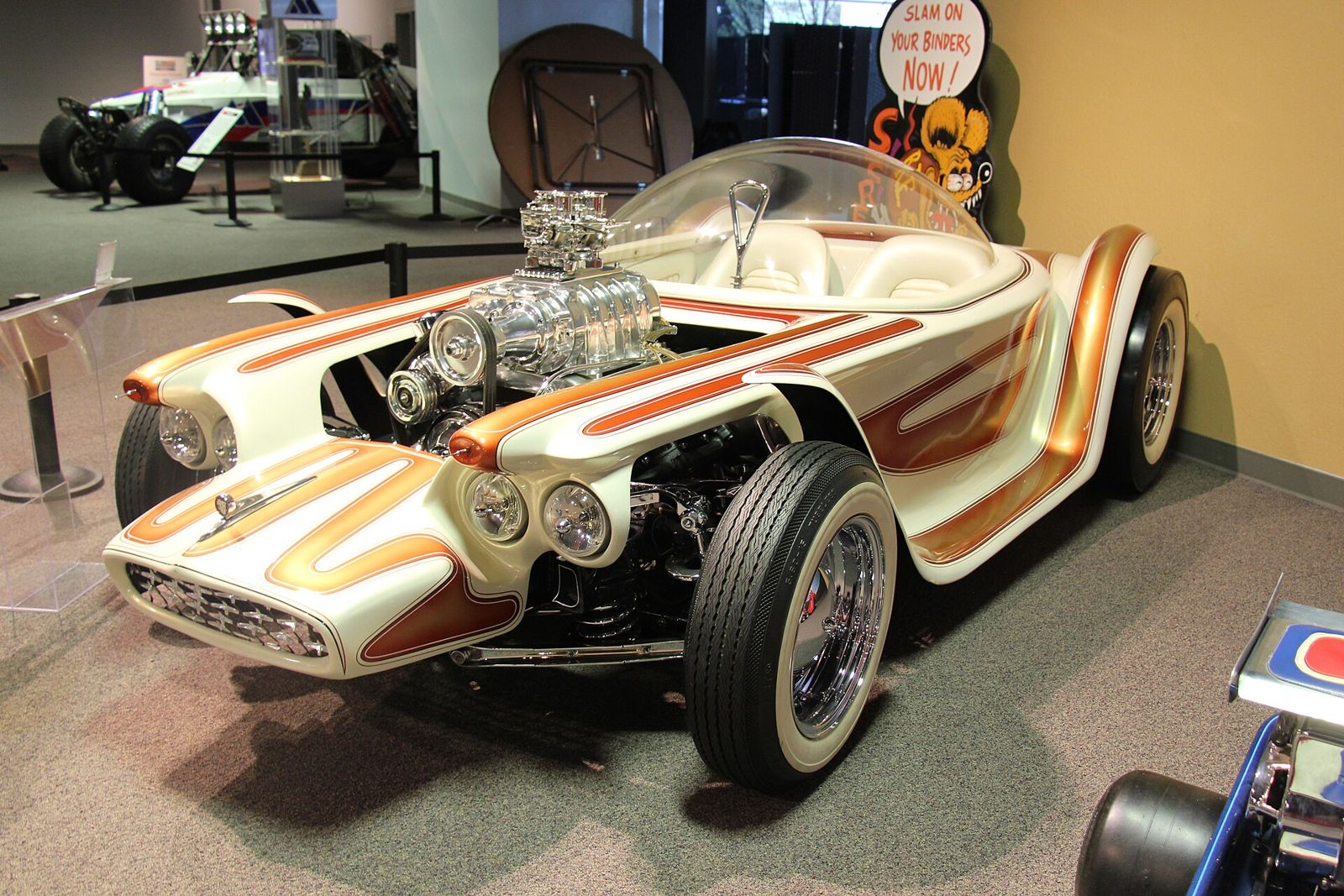
Ed Roth’s Beatnik Bandit (1960), photographed in 2015. It was one of the Roth show cars that Revell turned into kits. Creator: Sicnag. Date: 2015-08-14 07:44. Source: Wikimedia Commons. License: CC BY 2.0.

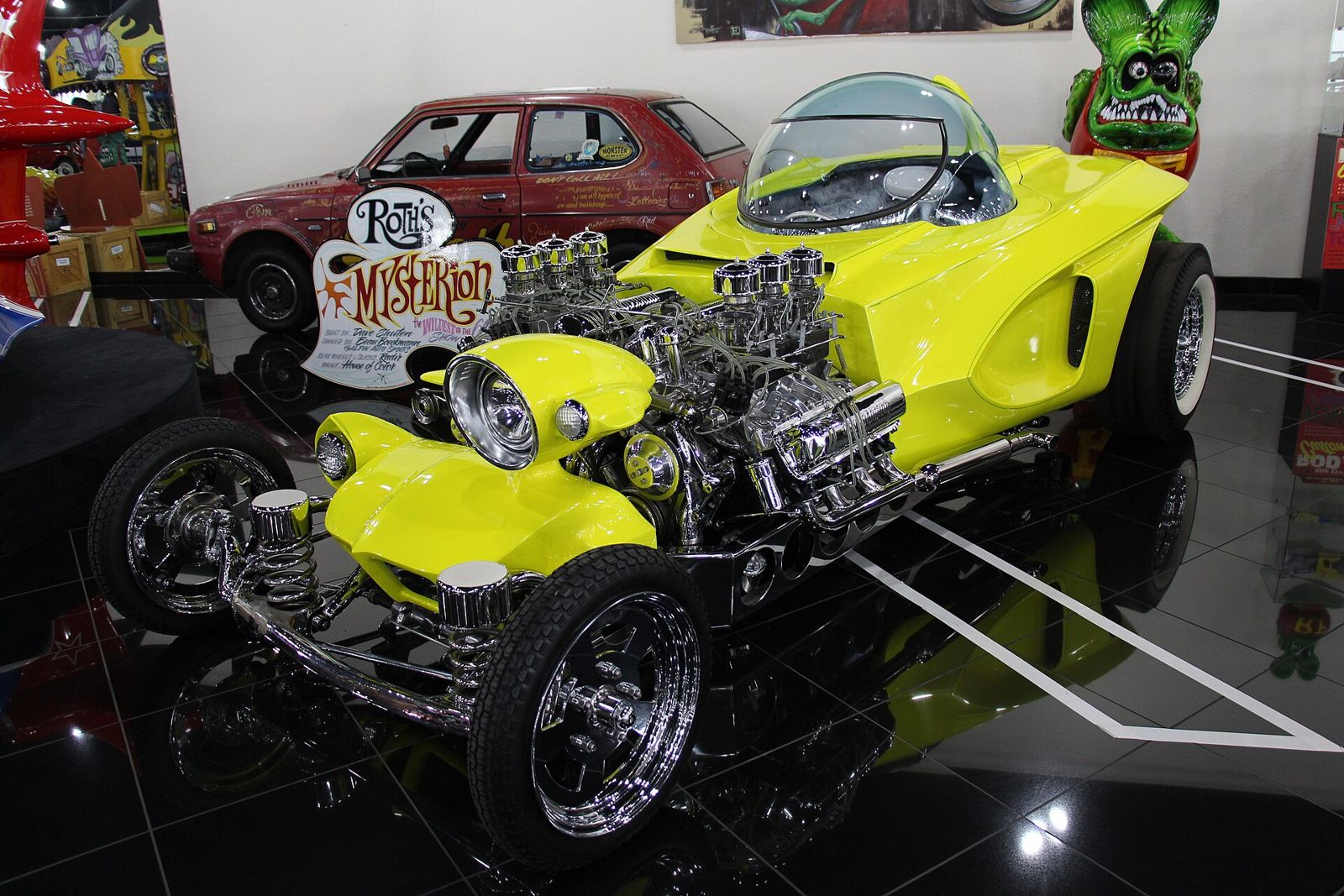
Roth’s Mysterion (1963), photographed in 2015. The uploader identifies the car; we have not checked whether this is the original or a recreation. Creator: Sicnag. Date: 2015-08-07 04:01. Source: Wikimedia Commons. License: CC BY 2.0.

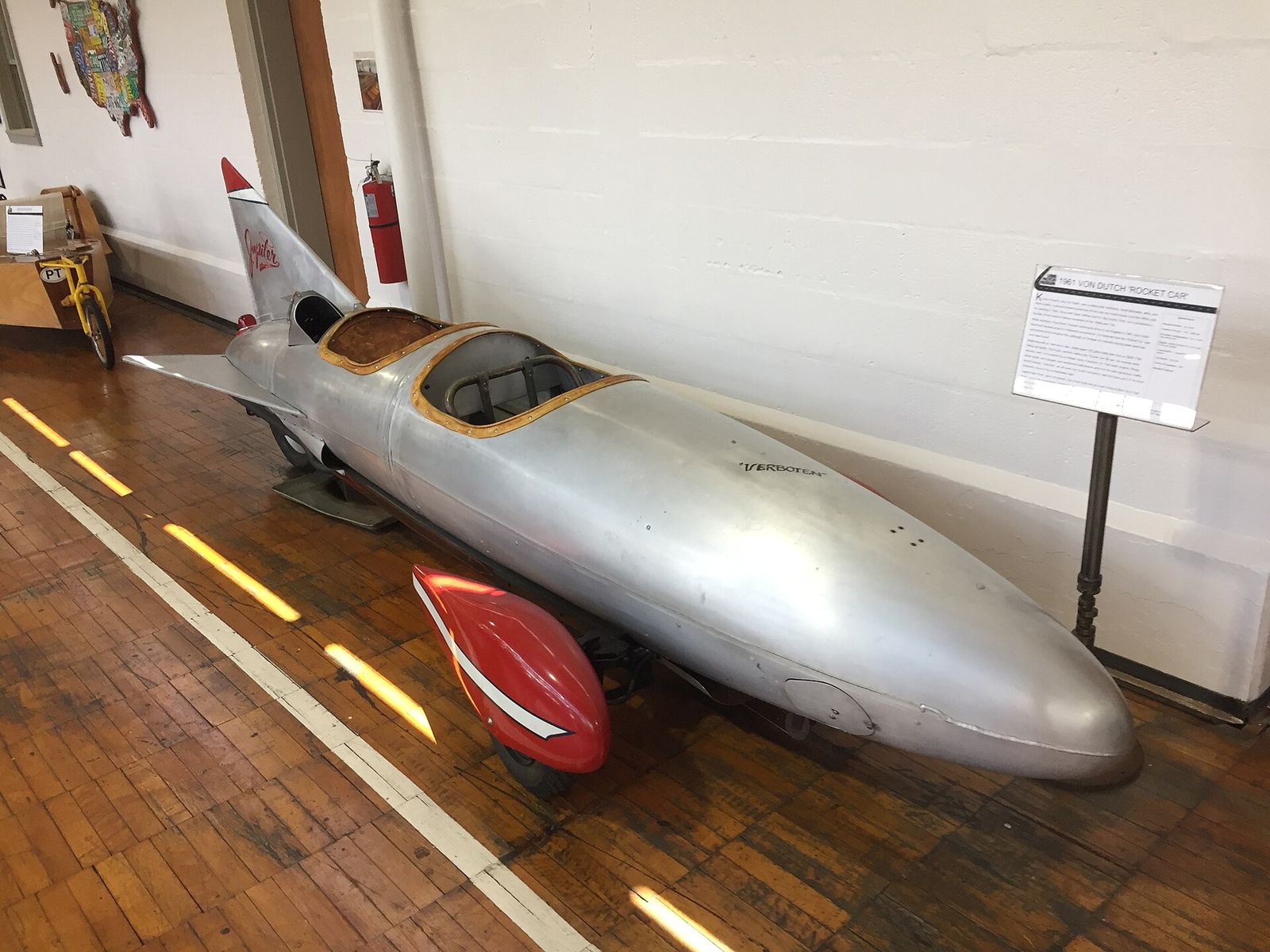
Von Dutch’s 1961 “Rocket Car” at the Lane Motor Museum. The museum label says it was built from an F-86 drop tank with a Harley flathead. Creator: Tim Farley. Date: 2017-08-19 13:07:45. Source: Wikimedia Commons. License: CC BY-SA 4.0.

Visual references (external)
These images are copyrighted, so we link to them instead.
- Kustomrama: Trend Book 101 page scans
- Centerline Hobbies: AMT kit boxes and flyers
- Museum of American Speed: Outlaw tribute
Sources & notes
9 notes
-
Kustomrama, “Trend Book 101 Custom Cars” (citing Barris Kustom Techniques of the 50’s Vol. 4). https://www.kustomrama.com/wiki/Custom_Cars_Trend_Book_No._101 (accessed 2026-10-13) ↩↩↩
-
99W Speed Shop, “Petersen Trend Books.” http://99wspeedshop.com/trendbooks.html (accessed 2026-10-13) ↩↩
-
Promotex Online, “3-in-1:87” (Cawthon, 2002). https://promotex.ca/articles/cawthon/2002/12-15-2002_article.html (accessed 2026-10-13) ↩↩
-
Round2, “AMT.” https://www.round2corp.com/amt-4/ (accessed 2026-10-13) ↩↩↩↩
-
Centerline Hobbies, “60’s AMT Kits Run Wild.” https://centerlinehobbies.com/kitsrunwild (accessed 2026-10-13) ↩
-
Crittenden Automotive Library, “AMT: History.” https://www.carsandracingstuff.com/library/a/amt_history.php (accessed 2026-10-13) ↩
-
Coachbuilt.com, “Gene Winfield.” http://www.coachbuilt.com/des/w/winfield/winfield.htm (accessed 2026-10-13) ↩↩
-
Museum of American Speed, “Outlaw Tribute”; Scalemates, Revell 1282. https://www.museumofamericanspeed.org/outlawtribute.html ; https://www.scalemates.com/kits/revell-1282-outlaw--195031 (accessed 2026-10-12) ↩
-
Rat Fink (Roth museum) biography. https://www.ratfink.com/ed-roth-museum/big-daddy-roth-bio (accessed 2026-10-13) ↩↩