Eras 1950s Santa Ana, California
Pappy Hart and the Bayonets
Orange County hot rodders raced on abandoned airstrips until, by one account, Marines with fixed bayonets ran them off. C.J. Hart opened the Santa Ana drags on June 19, 1950, and the county evicted him on June 21, 1959.
Confidence HighHow we know this
- Confidence
- High
- Source types
- obituaries (5+ agreeing), secondary
- Last verified
- 2026-10-27 (Round 24)
- Open issues
- Lions tenure conflict open; why a quarter mile ⚠
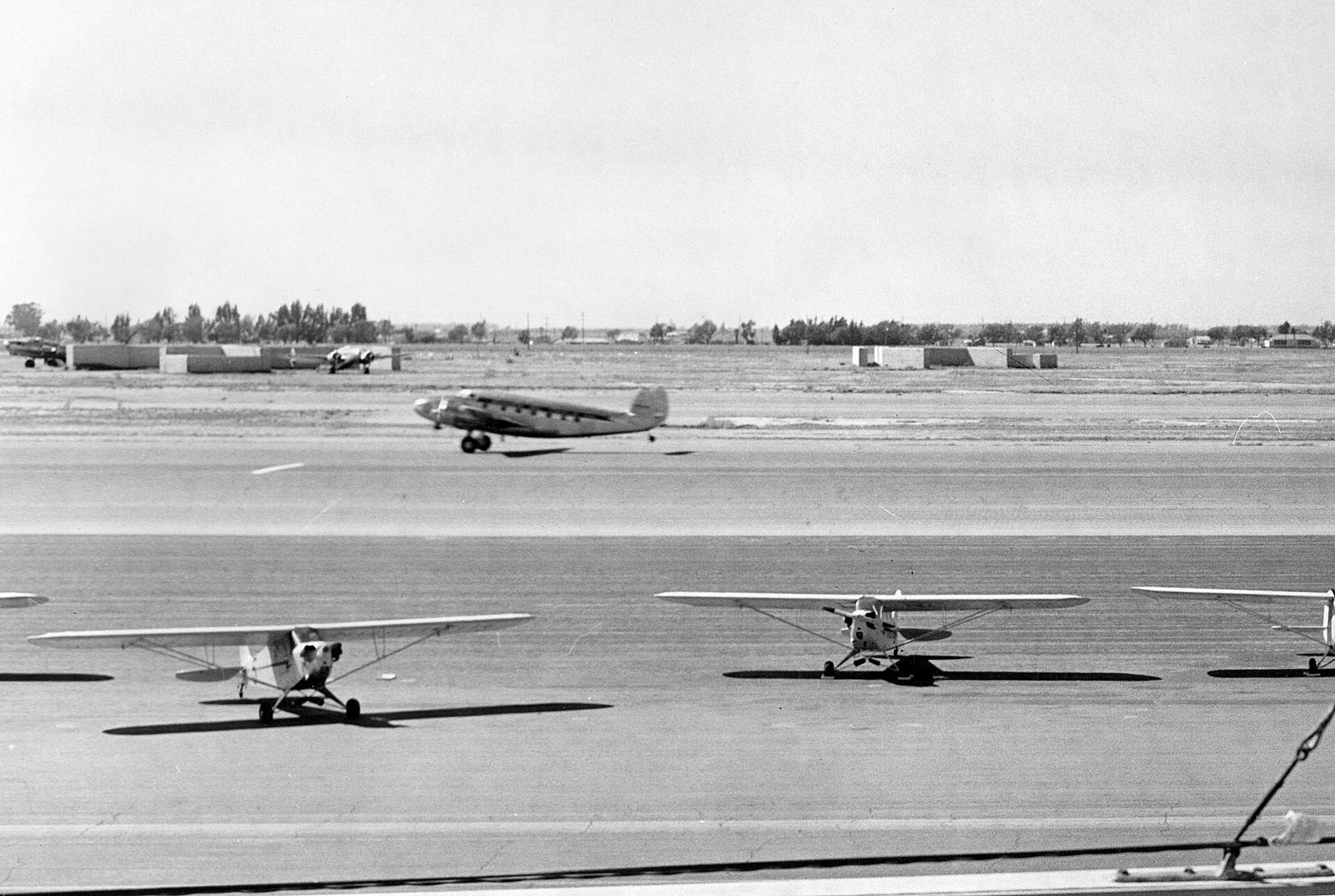
An Orange County Airport runway, circa 1950s (archive's date). We have not established which strip the drags used. Creator: Orange County Archives. Date: circa 1950date QS:P,+1950-00-00T00:00:00Z/9,P1480,Q5727902s. Source: Wikimedia Commons. License: CC BY 2.0. Courtesy line requested by the archive: "Photo courtesy Orange County Archives."

Santa Ana, 1950–59: by one account, Marines with fixed bayonets, then Pappy Hart’s strip, until the county evicted him
In their own words
“I saw a need to get people to stop racing on the streets; that was dangerous.”
— C.J. Hart, National Dragster interview, 2001 (quoted by NHRA.com, 2004). Full context in Voices
Routed by bayonets
In the late 1940s, Orange County hot rodders raced on abandoned wartime airstrips such as the Navy’s Mile Square, until, by one account, a company of U.S. Marines with fixed bayonets ran them off.1◐ C.J. “Pappy” Hart opened a strip at the airport on June 19, 1950. The same airport ended it on June 21, 1959.
Hart recalled the good part: “We used to run off seven, eight abreast... With that many cars running, you’d have to beat somebody!” The bad part came one Sunday, when, by that account, the Marines ran them off. His answer was a real strip.
The Orange County Airport manager (today John Wayne Airport) offered an unused strip if Hart paid the airport 10% of proceeds and got insurance. With less than $1,000, Hart, his wife Peggy, and two backers opened on June 19, 1950.1 The backers were Frank Stillwell and Creighton Hunter, fellow members of the Santa Ana Elks Lodge. The project had the blessing of CHP commissioner Clifford E. Peterson and the county supervisors, and Hunter and Stillwell sold out to Hart a few months in.2
It was a shoestring operation. The timing system was “cobbled together from an old Victrola” (NHRA, 2004).7
The gate was cheap. Spectators paid 50 cents, later raised to $1, and racers paid $1. The LA Times and NYT agree on this, as does the 2015 Press-Enterprise.52 The NYT adds a quarter more to watch the mechanics work.6 MSHF’s “50 cents, race or watch” looks like a simplification. The LA Times puts opening day at about 500 spectators and 50 cars, a typical Sunday at about 2,500, and the last day at over 4,000.5
It became a Sunday habit. Hart’s son Gerald recalled races every Sunday “except Mother’s Day. They tried it once and they wouldn’t let that happen again.” He said the only other strip he knew of was at Goleta.2 Peggy Hart raced her 1933 Willys coupe there.2 There was one fatality in nine years: a spectator struck by a flywheel.2
Hart was emphatic that he’d invented nothing: “I didn’t invent drag racing... When I was growing up in Ohio, every stoplight, every night was a race.”1
How the rules got invented
The rules came from wherever they could be found. The quarter mile, by Hart’s own account in his Hall of Fame biography, came from horse racing: “There was a lot of talk in those days that quarter horses were faster than cars,” he explained, and the public could relate to quarter-mile times.⚠ Timing started with a stopwatch, then homemade electric timers.1
Classes came next: stockers split by axle ratio, model year and displacement, with “hot-car” classes added when lakes racers showed up, along with the first cash awards. The “Dollar-A-Mile” program paid Top Eliminator $1 per mph.1
The cars soon tested those rules. Chet Herbert’s stripped Harley “The Beast” ran 121 and then 129 mph at Santa Ana in 1950, beating every bike and car there.4
The airport that made the strip possible also ended it. The strip ran until June 21, 1959, when the county evicted Hart to expand the airport.2 In 1965 he succeeded Mickey Thompson as manager of Lions Drag Strip, staying until 1971. There he created the Junior Fuel class and developed bracket and grudge racing.32
Hart died on June 25, 2004. NHRA, the Orange County Register, the NYT, AP and the Press-Enterprise all give June 25, and the NYT and AP quote his son Gerald.76 The LA Times wrote “died Saturday” (June 26) and MSHF gives June 26. Both are outliers.?
By that account, the bayonets had run them off the airstrips. Hart opened the drags on June 19, 1950. On June 21, 1959, the county evicted him to expand the airport.
Open questions & disputed details
3 items
From the detective’s notebook: where the sources disagree, where we have only one, and what we are still looking for. Each item links back to its place in the story.
Single source so far. Did the Marines run them off? The bayonet story comes only from the Hall of Fame biography; we have not found a period report.1 ↩
Open question. June 25 or June 26, 2004? NHRA, the Orange County Register, the NYT, AP and the Press-Enterprise give June 25 for Hart’s death, and the NYT and AP quote his son Gerald.76 The LA Times wrote “died Saturday” (June 26), and MSHF gives June 26. We follow the majority; a death record would settle it. ↩
Disputed. Was the quarter mile really borrowed from horse racing? A much earlier account says no. In 1968 the Texas folklorist Hermes Nye thanked Ralph Guldahl, Jr., “of the Lions Drag Strip,” for answering his question about the distance, and printed the answer: “No, it was not based on the quarter-horse race distance, but was fixed by C. J. Hart and the racers at Santa Ana Airport, where there was limit[e]d shut-off space.” That is a secondhand answer from a Lions man, written down 18 years after Santa Ana opened (the essay cites the 1966 Charger as new, so it was probably written about 1966). The horse-racing explanation is Hart’s own, quoted in Dave Wallace’s Hall of Fame nomination biography (Class of 1999; the date of the interview is not given), though the biography’s narration mixes “quarter horses” with “thoroughbred racing.” Each may hold part of the story. See T-Bones and Cheater Slicks.81 ↩
More from the notebook
⚠ Lions tenure is still in conflict: 1965–71 per MSHF and SEMA, 1963–1970 per the OC Register.7 See also Peggy Hart.
⚠ Round 10 notes: (1) June 19, 1950, was a Monday. The Long & Tuttle clippings pamphlet dates the “first race” to Sunday, July 2, 1950. See Peggy Hart. (2) The same January 1980 Hot Rod profile that dates Hart’s Lions start to “’65” also refers to “his very first act in ’63.” The 1965 date fits its own statement that he succeeded Mickey Thompson, who left in 1963.9
Images
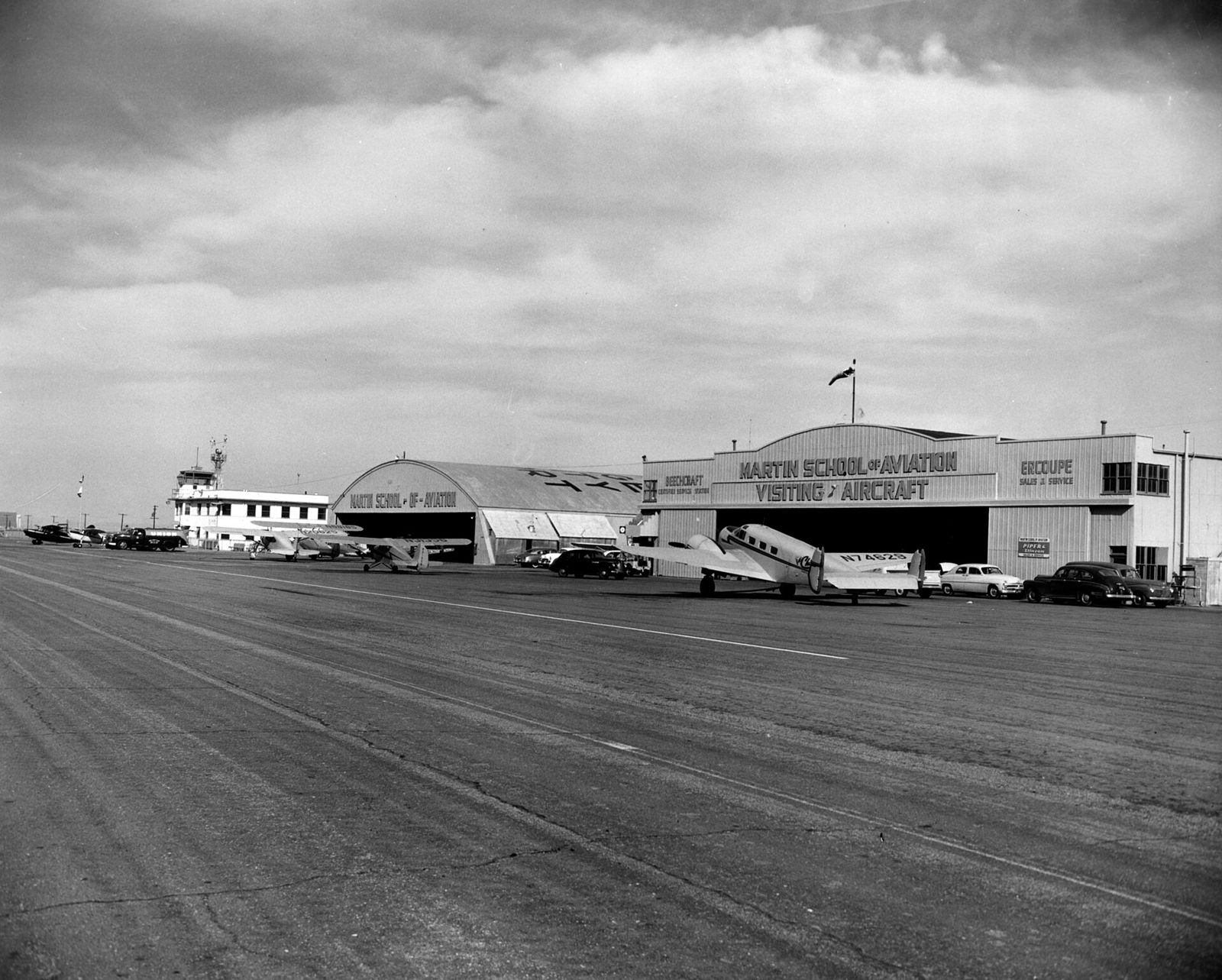
Orange County Airport in the 1950s, the airport whose unused strip hosted the Santa Ana Drags (1950–59). The view is not dated more precisely and does not show the drags. Creator: Orange County Archives. Date: 1950s (archive’s date). Source: Wikimedia Commons. License: CC BY 2.0. Courtesy line requested by the archive: “Photo courtesy Orange County Archives.”

Visual references (external)
These are copyrighted or rights-restricted images, so we link to them instead of copying them.
Sources & notes
9 notes
-
Dave Wallace, “C. J. Hart,” Motorsports Hall of Fame of America. https://www.mshf.com/hall-of-fame/inductees/c-j-hart.html (accessed 2026-10-12) ↩↩↩↩↩↩↩
-
Johan Moreno, “Santa Ana Drags: 65 years after...,” Press-Enterprise, Oct 1, 2015. https://www.pressenterprise.com/2015/10/01/santa-ana-drags-65-years-after-the-strip-was-founded-it-still-brings-back-fond-racing-memories/ (accessed 2026-10-13) ↩↩↩↩↩↩↩
-
SEMA Hall of Fame 1981, “C.J. Hart.” https://www.sema.org/hof/1981/cj-hart (accessed 2026-10-12) ↩
-
Daniel Strohl, “Chet Herbert,” Hemmings, Sept 23, 2018. https://www.hemmings.com/stories/chet-herbert/ (accessed 2026-10-12) ↩
-
Shav Glick, LA Times, June 30, 2004. https://www.latimes.com/archives/la-xpm-2004-jun-30-me-hart30-story.html (accessed 2026-10-13) ↩↩
-
New York Times obituary, July 4, 2004, reproduced at wediditforlove.com. https://wediditforlove.com/cj-2.html (accessed 2026-10-13) ↩↩↩
-
Phil Burgess, NHRA.com, 2004, and the OC Register / AP obituaries, reproduced at wediditforlove.com. https://wediditforlove.com/cj-2.html (accessed 2026-10-13) ↩↩↩↩
-
Hermes Nye, “T-Bones and Cheater Slicks: The Folksay of the Drag Strip,” in Wilson M. Hudson, ed., Tire Shrinker to Dragster, Publications of the Texas Folklore Society 34 (Austin: Encino Press, 1968), pp. 34–35 (author’s note). Page OCR via the Portal to Texas History. https://texashistory.unt.edu/ark:/67531/metadc38875/m1/45/ocr/ (accessed 2026-10-23) ↩
-
Dave Wallace, “The Hart of Drag Racing,” Hot Rod, January 1980 (web reprint 2023). Accessed 2026-10-15. https://www.hotrod.com/features/the-hart-of-drag-racing-january-1980-982-1130-22-1 ↩